A retrospective of the academic material created and made available through Prateek Bhatt and AKriti IAS—showing what to recognise in Prelims, what to explain in Mains and which connections make knowledge usable.
The portfolio brings together the intellectual ground covered across NewsDigest, questions and answer-writing practice, information sheets, infographics, Prelims Lens, model answers, teaching notes, ethics and thinkers, classroom board-work, and structured reading pathways.
NewsDigest
Prelims Lens
Mains Answer Writing
Information Sheets
Infographics
Model Answers
Ethics
Reading Pathways
Revision
The central idea: a topic learnt is several answers waiting to happen. This document maps facts to arguments, arguments to examples and examples to exam-ready judgment.
AKriti IAS · The Learning Portfolio · 65 pages · Updated to 21 October 2026
15 October 2026GS II · Governance & Welfare Delivery · GS III · Inclusive Growth
Current Affairs · Governance & Development
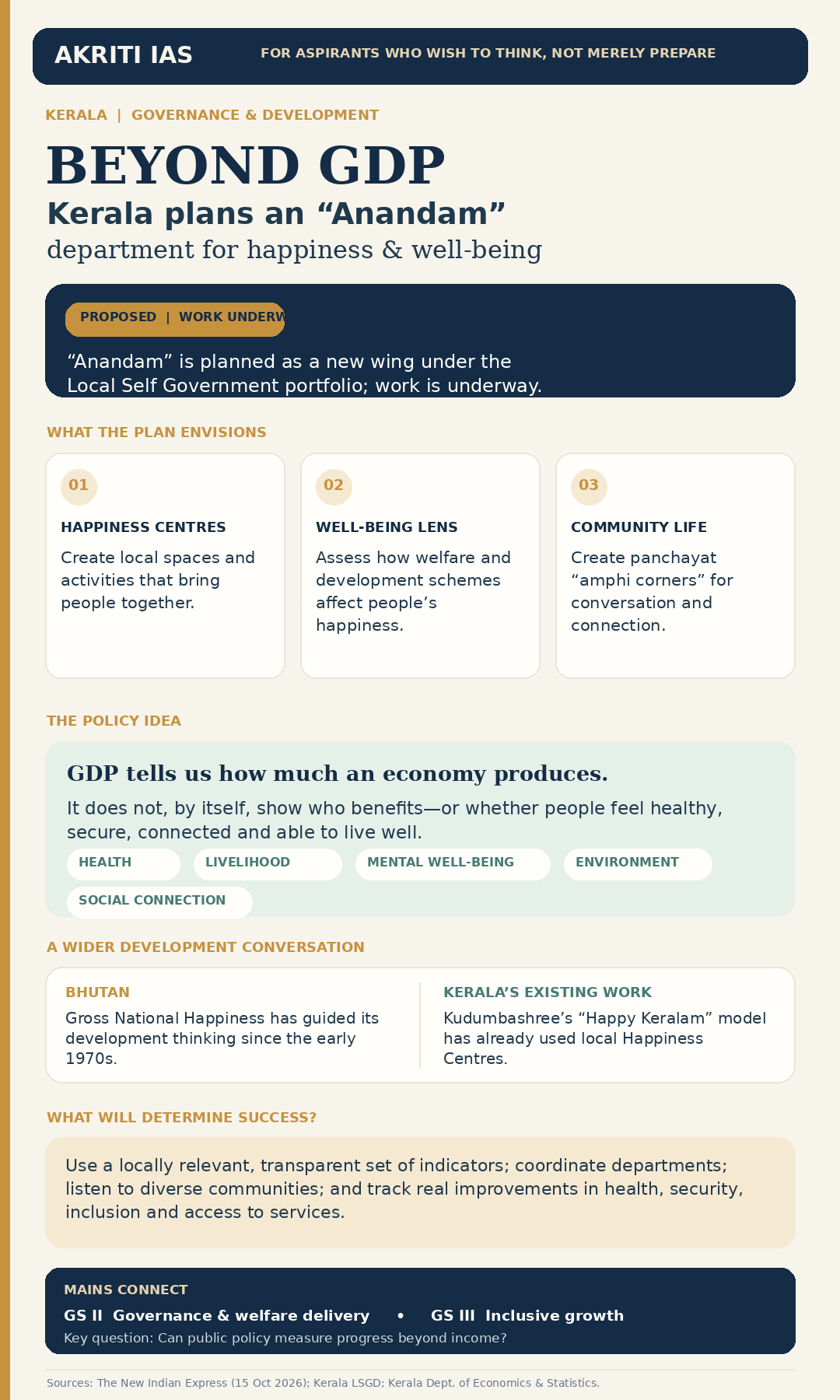
Beyond GDP: Kerala plans an “Anandam” department
Kerala is planning “Anandam” as a new wing under the Local Self Government portfolio, bringing happiness and well-being into the conversation on public policy and development.
The infographic explains the proposed happiness centres, a well-being lens for welfare schemes and community spaces at the panchayat level. It also distinguishes economic output from lived well-being and places the proposal alongside Bhutan’s Gross National Happiness approach and Kerala’s existing “Happy Keralam” work.
Kerala
Anandam
Happiness index
Beyond GDP
Local governance
Welfare delivery
Inclusive growth
Well-being
GS II
GS III
Mains Connect: Can public policy measure progress beyond income? Examine the value—and the design challenges—of incorporating health, security, inclusion, environment and social connection into development assessment.
AKriti IAS · Governance & Development · GS Paper II & GS Paper III
13 October 2026GS Paper III · Economic Development · Prelims + Mains
Current Affairs · Economy
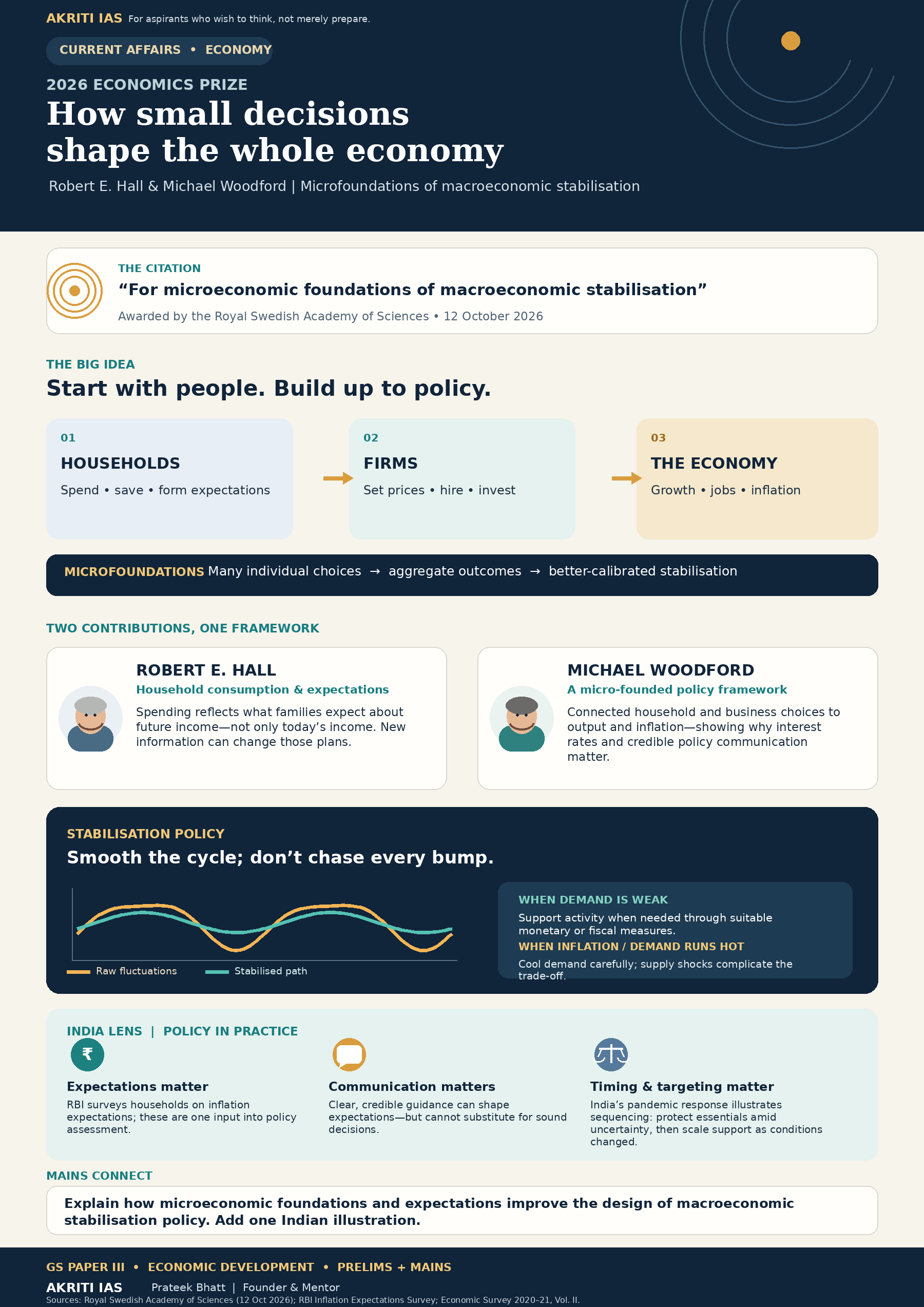
2026 Economics Nobel: How Small Decisions Shape the Whole Economy
Robert E. Hall and Michael Woodford received the 2026 Prize in Economic Sciences “for microeconomic foundations of macroeconomic stabilisation.” Their work explains how the choices and expectations of households and firms combine to shape inflation, employment, growth and the effectiveness of public policy.
The infographic moves from individual decisions to aggregate outcomes, then shows why timing, credibility and communication matter for monetary and fiscal stabilisation. Its India lens connects the framework to inflation expectations, central-bank communication and the sequencing of policy support.
Robert E. Hall
Michael Woodford
Microfoundations
Macroeconomic stabilisation
Expectations
Monetary policy
Fiscal policy
GS III
Mains Connect: Explain how microeconomic foundations and expectations improve the design of macroeconomic stabilisation policy, using an Indian illustration.
AKriti IAS · Current Affairs · Economy · GS Paper III · Prelims + Mains
13 October 2026GS IV · Ethics · Public service values · Guru Nanak
Ethics Concept · UPSC 2023 Connect
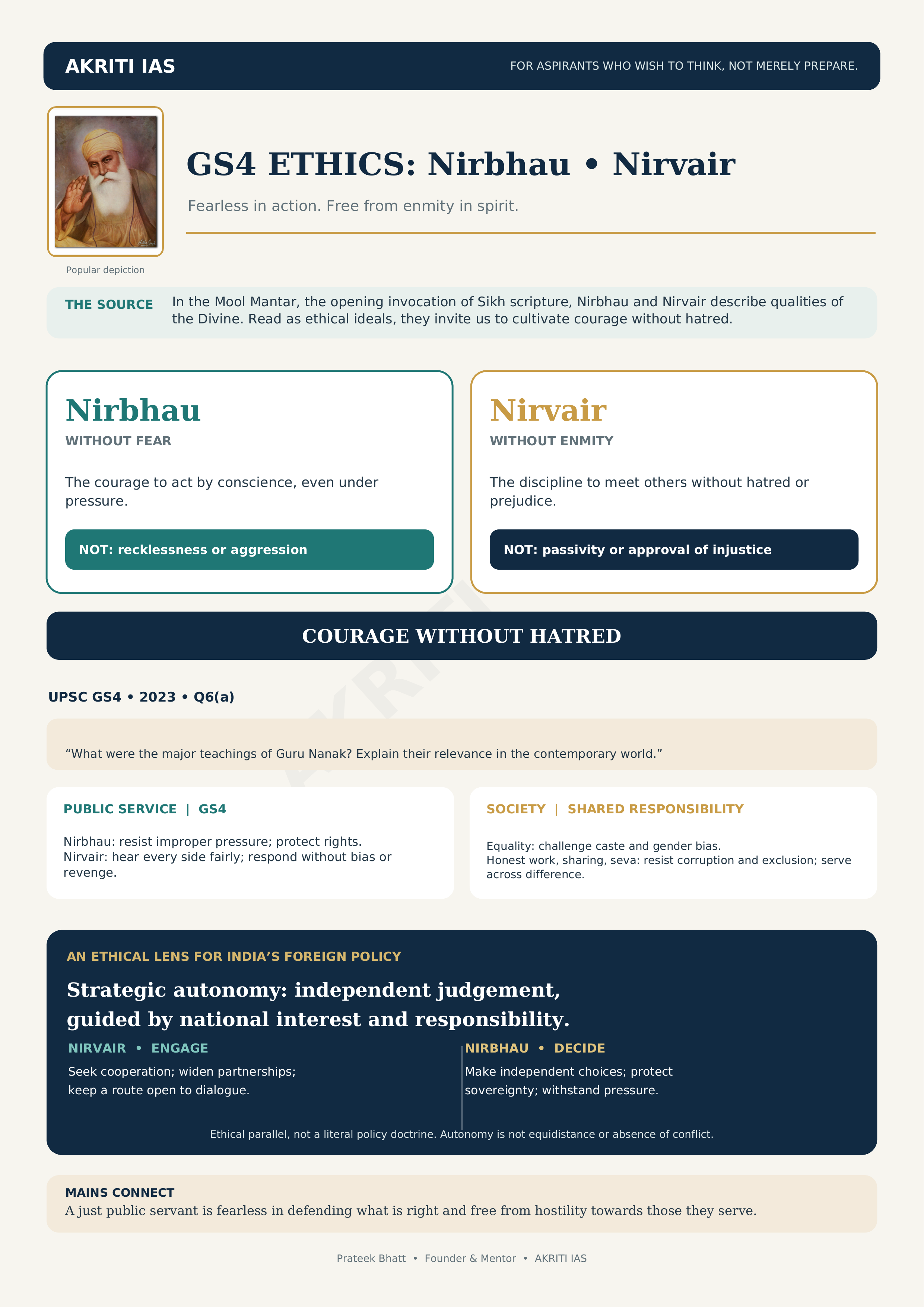
Nirbhau and Nirvair: courage without hatred
Nirbhau—without fear—and Nirvair—without enmity—describe qualities of the Divine in the Mool Mantar. Read as ethical ideals, they invite courage guided by conscience and action free from hostility.
The distinction matters. Fearlessness is not recklessness or aggression; freedom from enmity is not passivity or approval of injustice. Together, the concepts offer a demanding ethic for public service: withstand pressure, protect rights, hear every side fairly and act without bias or revenge.
Nirbhau
Nirvair
Guru Nanak
Mool Mantar
Fearlessness
Compassion
Public service
Strategic autonomy
GS IV
UPSC 2023
Mains Connect: A just public servant is fearless in defending what is right and free from hostility towards those they serve. The same ethical pairing can illuminate independent judgment, dialogue and responsibility in India’s external conduct.
AKriti IAS · GS IV Ethics · Guru Nanak · Public service values · UPSC 2023
12 October 2026GS II · Fundamental Rights · Governance · International institutions · GS IV
Visual Explainer · Rights & Public Order
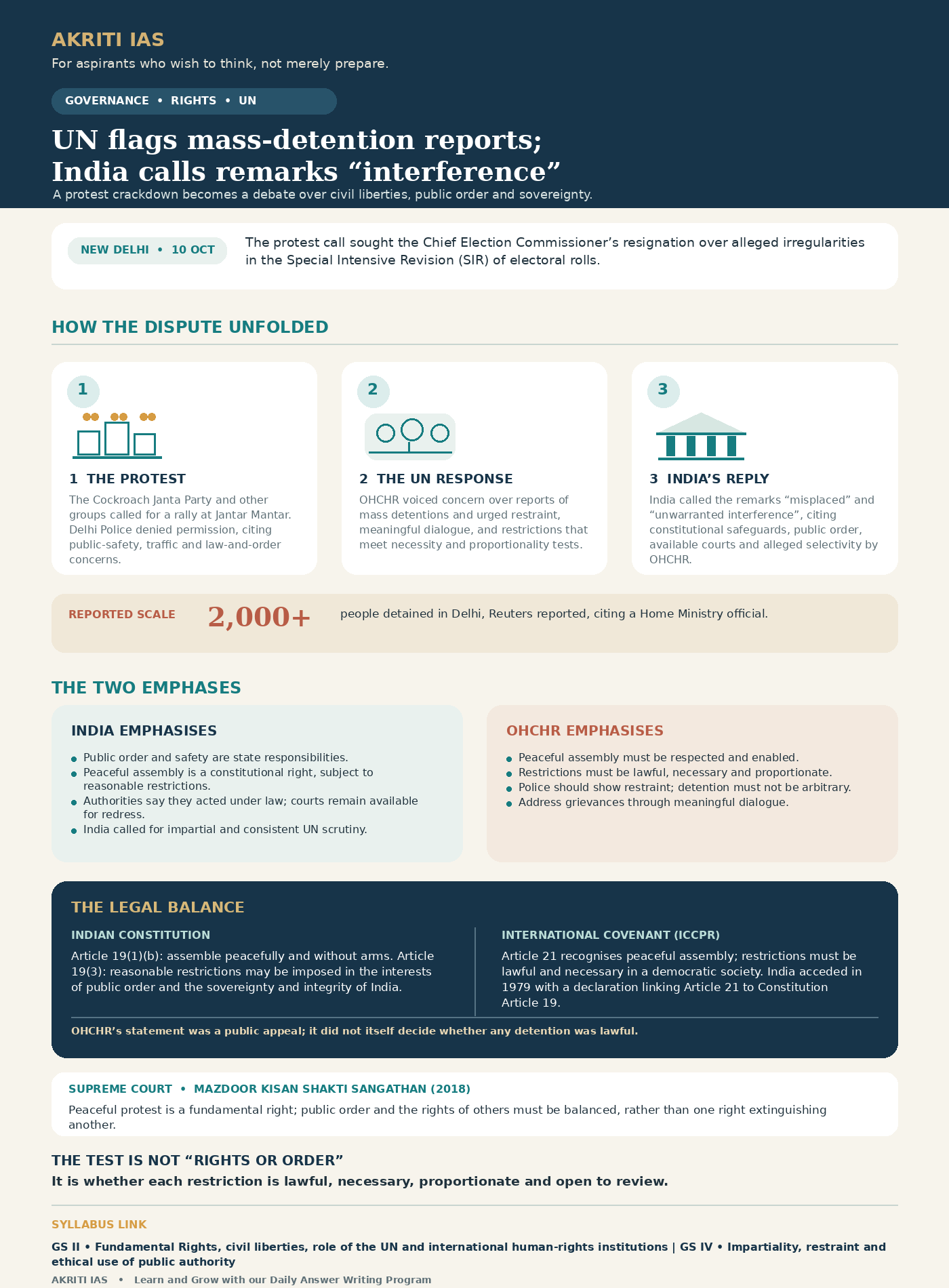
Delhi protests: rights, public order and sovereignty
Reports of mass detentions during a Delhi protest prompted concern from the UN human-rights office—and a firm Indian response describing the remarks as misplaced interference.
The infographic separates the competing emphases without collapsing the issue into a false choice: India stresses public order, constitutional safeguards and sovereign responsibility; OHCHR stresses peaceful assembly, restraint, legality and proportionality. It then connects the dispute to Article 19 of the Constitution, Article 21 of the ICCPR and the Supreme Court’s balancing approach.
Delhi protests
Peaceful assembly
Article 19
Public order
OHCHR
ICCPR Article 21
Civil liberties
Sovereignty
Proportionality
GS II
GS IV
UPSC Lens: The constitutional question is not “rights or order.” Restrictions on assembly must be grounded in law, pursue a legitimate public-order aim, remain necessary and proportionate, and stay open to judicial review.
AKriti IAS · GS II · Fundamental Rights · Governance · International institutions · GS IV
12 October 2026GS I · Himalayan rivers and geomorphic hazards · GS III · Disaster management
Field Note · Nepal
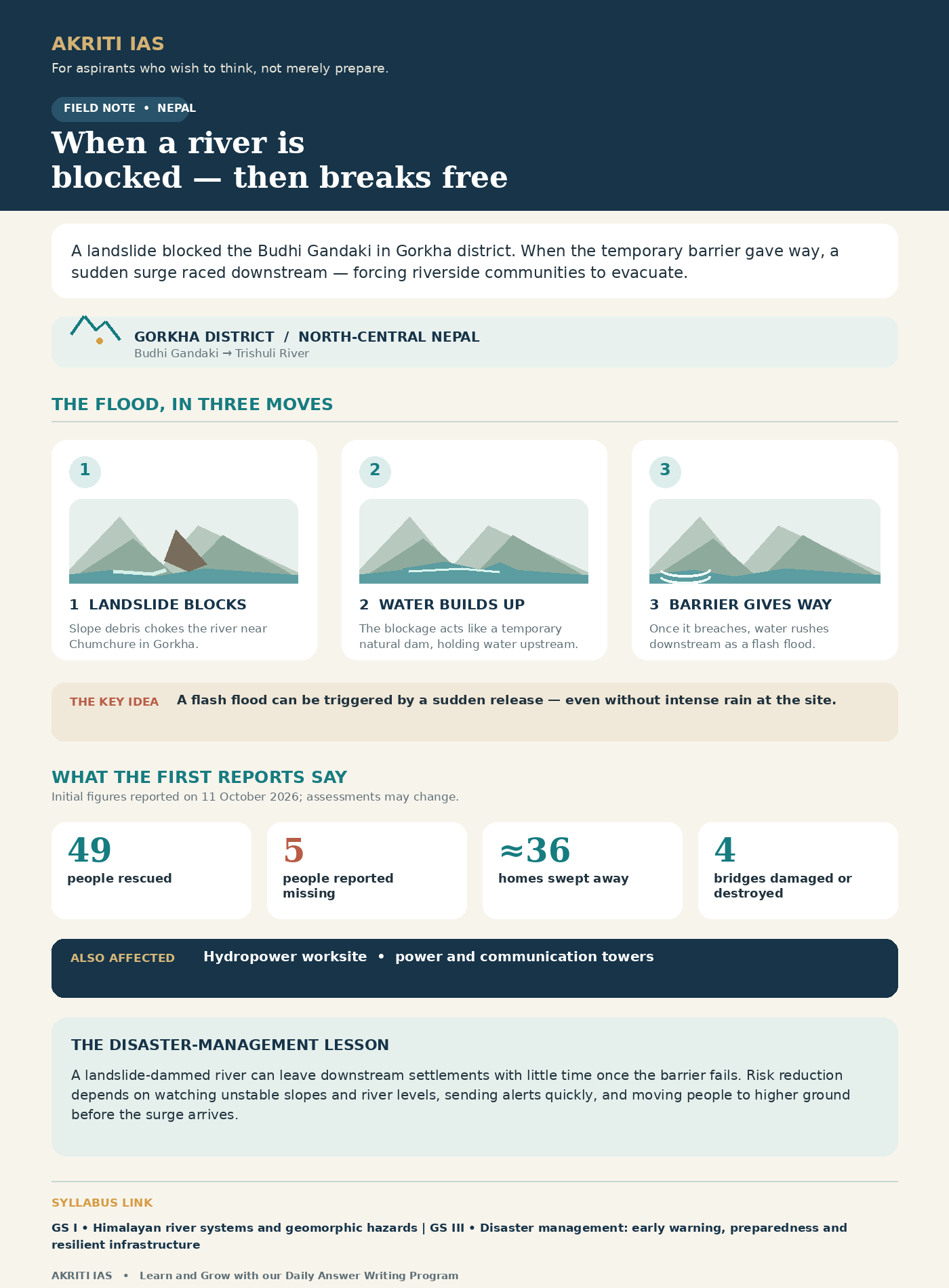
When a river is blocked—then breaks free
A landslide blocked the Budhi Gandaki in Nepal's Gorkha district. When the temporary natural barrier failed, the sudden release of impounded water produced a destructive downstream flash flood.
The visual explainer traces the event in three movements: slope debris chokes the river; water builds behind the blockage; and the barrier gives way. It also records the initial impact figures reported on 11 October, including rescues, missing people, homes swept away and damaged bridges.
Budhi Gandaki
Gorkha district
Himalayan rivers
Landslide dam
Flash flood
Geomorphic hazards
Early warning
Disaster management
GS I
GS III
UPSC Lens: Flash floods need not begin with intense rainfall at the affected site. A sudden breach of a landslide-dammed river can leave downstream settlements with very little warning, making slope monitoring, river-level surveillance, rapid alerts and timely evacuation essential.
AKriti IAS · GS I · Himalayan river systems · GS III · Disaster management
10 October 2026Prelims 2027 · GS · CSAT · MCQ practice
Open Practice Plan · Eight Pages
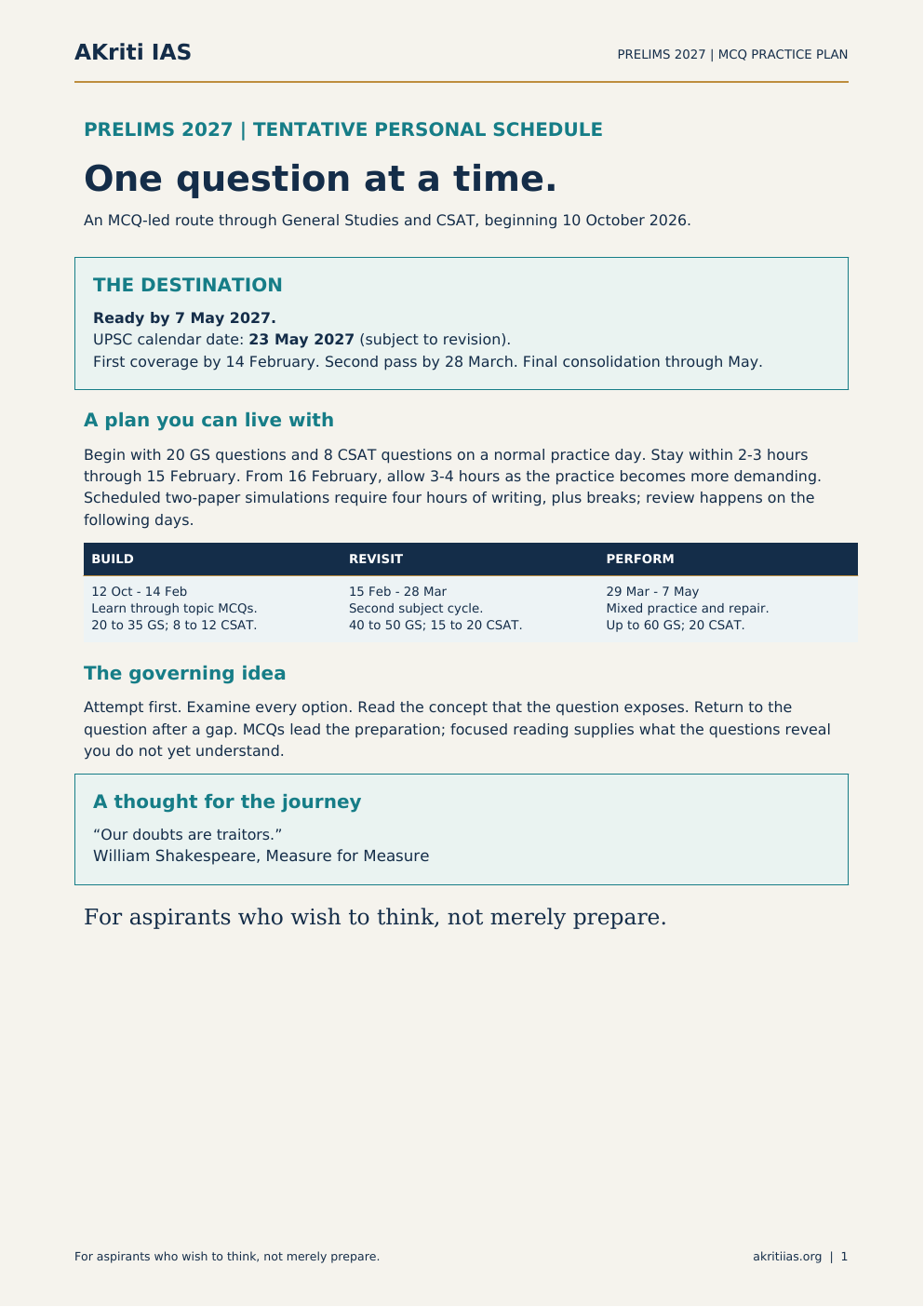
One question at a time.
A manageable MCQ-led route through the complete Prelims syllabus—designed to build gradually, revisit deliberately and practise the whole examination before 7 May 2027.
The schedule begins with modest daily targets and progressively raises the question load. It provides two complete subject passes, continuing current-affairs practice, dedicated CSAT work, timed full-length GS and CSAT papers, OMR practice, error-log revision and a final syllabus audit.
UPSC Prelims 2027
General Studies
CSAT
MCQ practice
PYQs
Full-length tests
Revision
Error log
OMR practice
How to use it: Attempt first, examine every option, study the concept exposed by the question and reattempt it after a gap. Treat wrong and guessed answers as the raw material of improvement.
AKriti IAS · Prelims 2027 · GS & CSAT · MCQ Practice Plan
10 October 2026GS II · International Relations · GS III · Internal Security
South Asia · India’s Neighbourhood
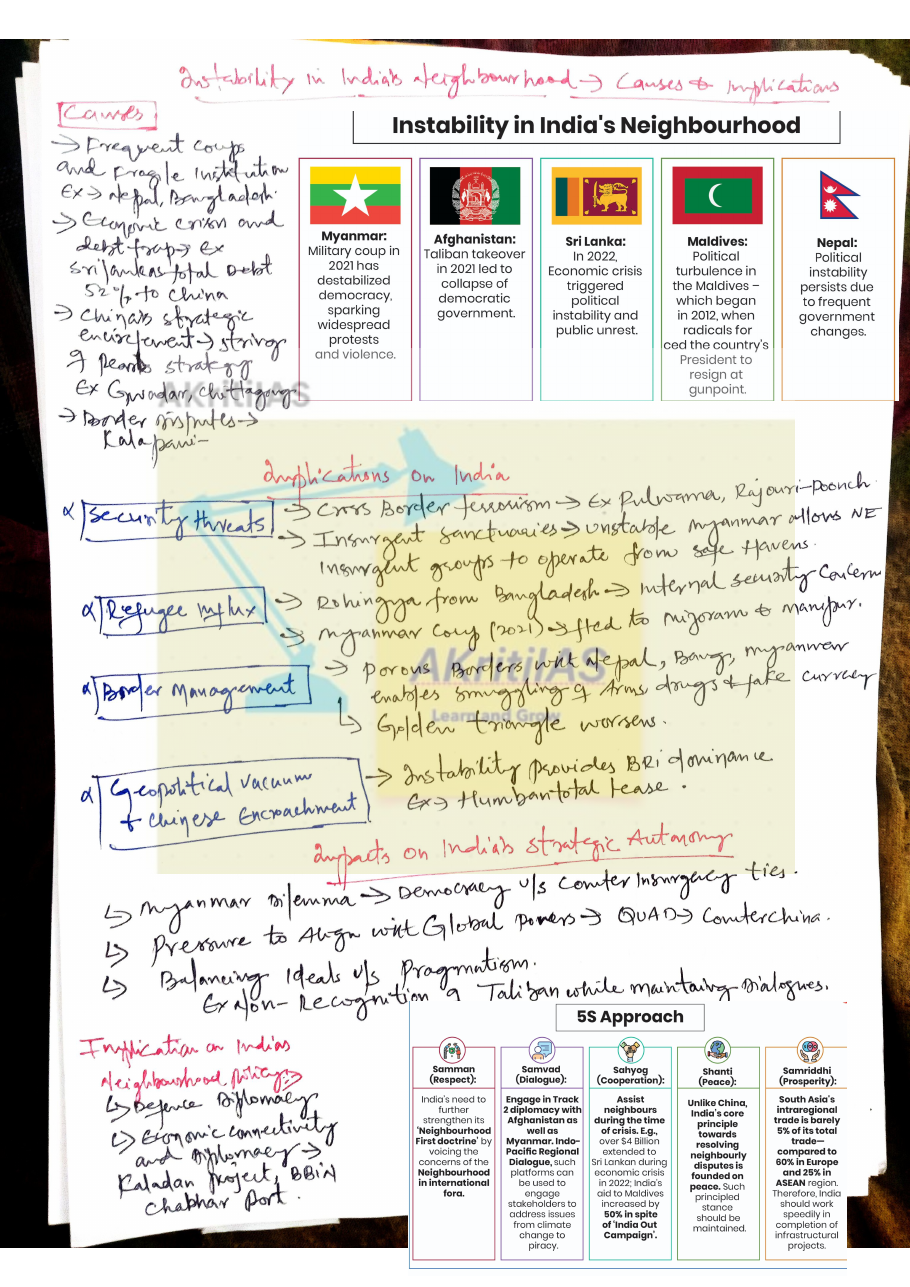
Instability in India’s neighbourhood
Political upheaval, economic distress and fragile institutions in neighbouring countries can quickly shape India’s security and regional environment. This one-page explainer maps the causes of instability across Myanmar, Afghanistan, Sri Lanka, the Maldives and Nepal.
It traces the implications for cross-border security, refugee movements, border management, Chinese influence and India’s strategic autonomy. The closing “5S” framework presents a neighbourhood response through Samman, Samvad, Sahayog, Shanti and Samriddhi.
India’s neighbourhood
South Asia
Myanmar
Afghanistan
Sri Lanka
Maldives
Nepal
Refugees
Border management
Strategic autonomy
GS II
GS III
Mains Connect: Regional stability is closely linked to India’s own security. A credible neighbourhood policy must combine principled diplomacy, practical cooperation and sustained regional connectivity.
AKRITI IAS · GS Paper II · International Relations · GS Paper III · Daily Learning
9 October 2026GS II · GS IV · Essay · Political theory
Thinkers & Ideas · Michel Foucault
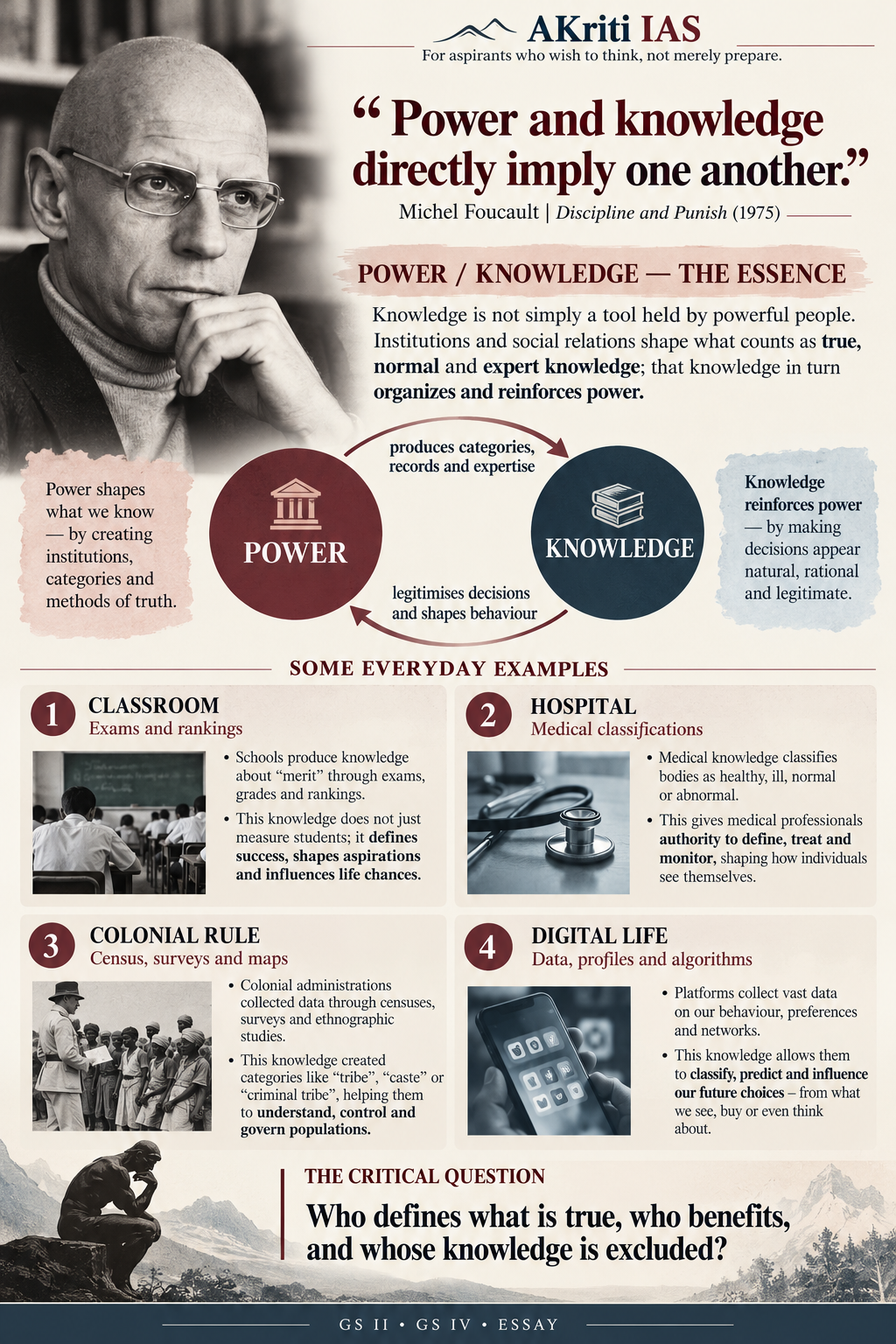
“Power and knowledge directly imply one another.”
For Michel Foucault, knowledge is not merely a neutral possession of powerful people. Institutions and social relations help determine what is accepted as true, normal and authoritative—and that knowledge, in turn, organises and reinforces power.
The infographic traces this two-way relationship through the classroom, hospital, colonial administration and digital platforms. Each example asks how categories, records and expertise shape behaviour, distribute authority and define the limits of what appears natural or legitimate.
Michel Foucault
Power–knowledge
Institutions
Discourse
Normalisation
Surveillance
GS II
GS IV
Essay
UPSC Lens: Use the framework to analyse institutional authority, governance, expert knowledge, data power and the ethical question of whose knowledge is recognised—or excluded.
AKRITI IAS · GS II · GS IV · Essay · Daily Learning
9 October 2026Literature · 2026 Nobel Prize · Classical tradition
Nobel Prize in Literature 2026 · Anne Carson
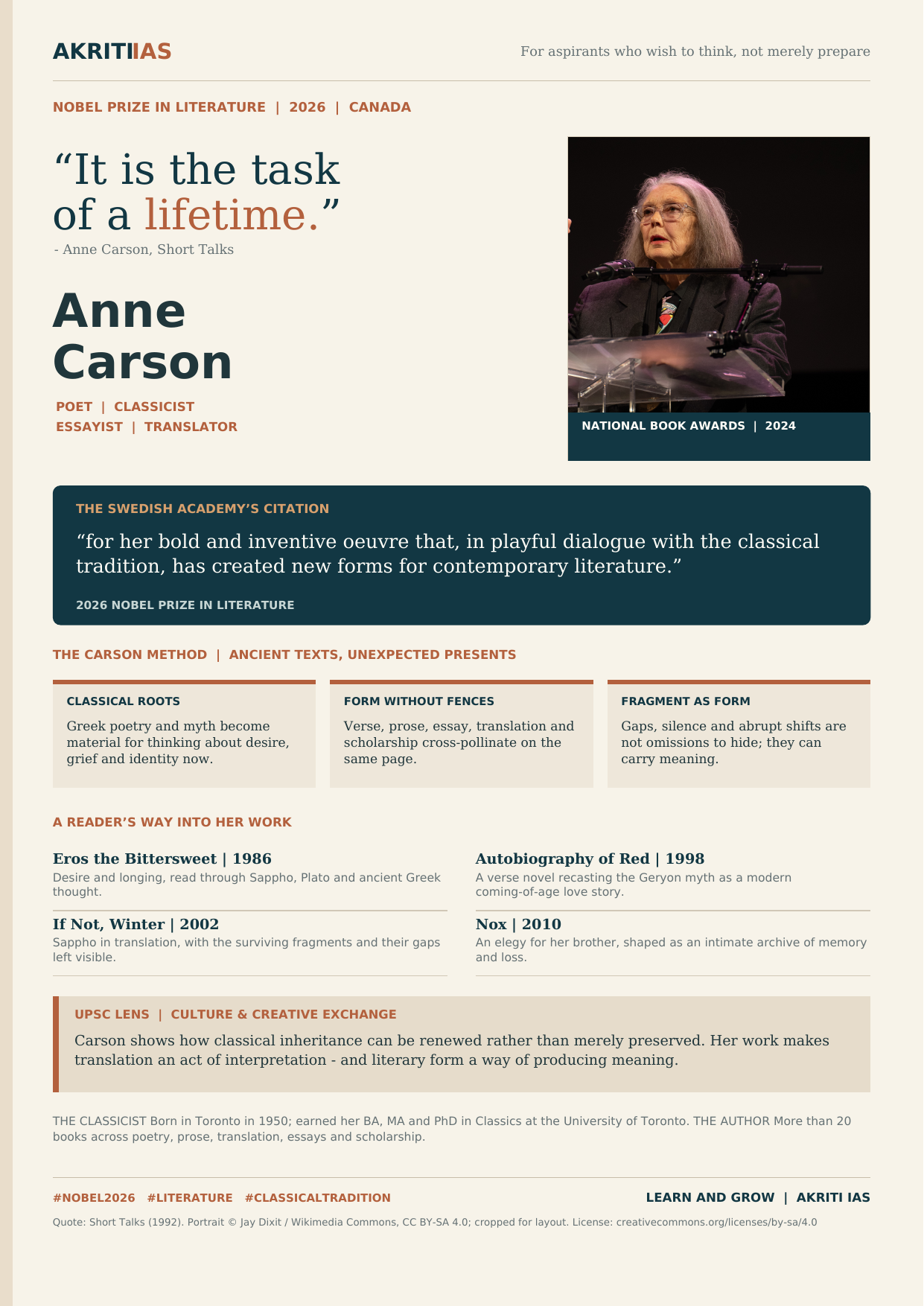
“It is the task of a lifetime.”
A poet, classicist, essayist and translator, Anne Carson brings ancient Greek literature into conversation with contemporary experience - and makes form itself part of the meaning.
This one-page infographic introduces the Swedish Academy’s Nobel citation, Carson’s genre-crossing method and four works: Eros the Bittersweet, Autobiography of Red, If Not, Winter and Nox.
Anne Carson
Nobel Prize in Literature 2026
Classical tradition
Autobiography of Red
Sappho
Translation
Literary form
UPSC Lens: Carson’s work shows how classical inheritance can be renewed through translation, literary form and creative exchange.
AKRITI IAS · Literature · 2026 Nobel Prize · Daily Learning
8 October 2026GS III · Science & Technology · Chemistry
Chemistry Nobel 2026 · Molecular handedness
When chemistry chooses a side
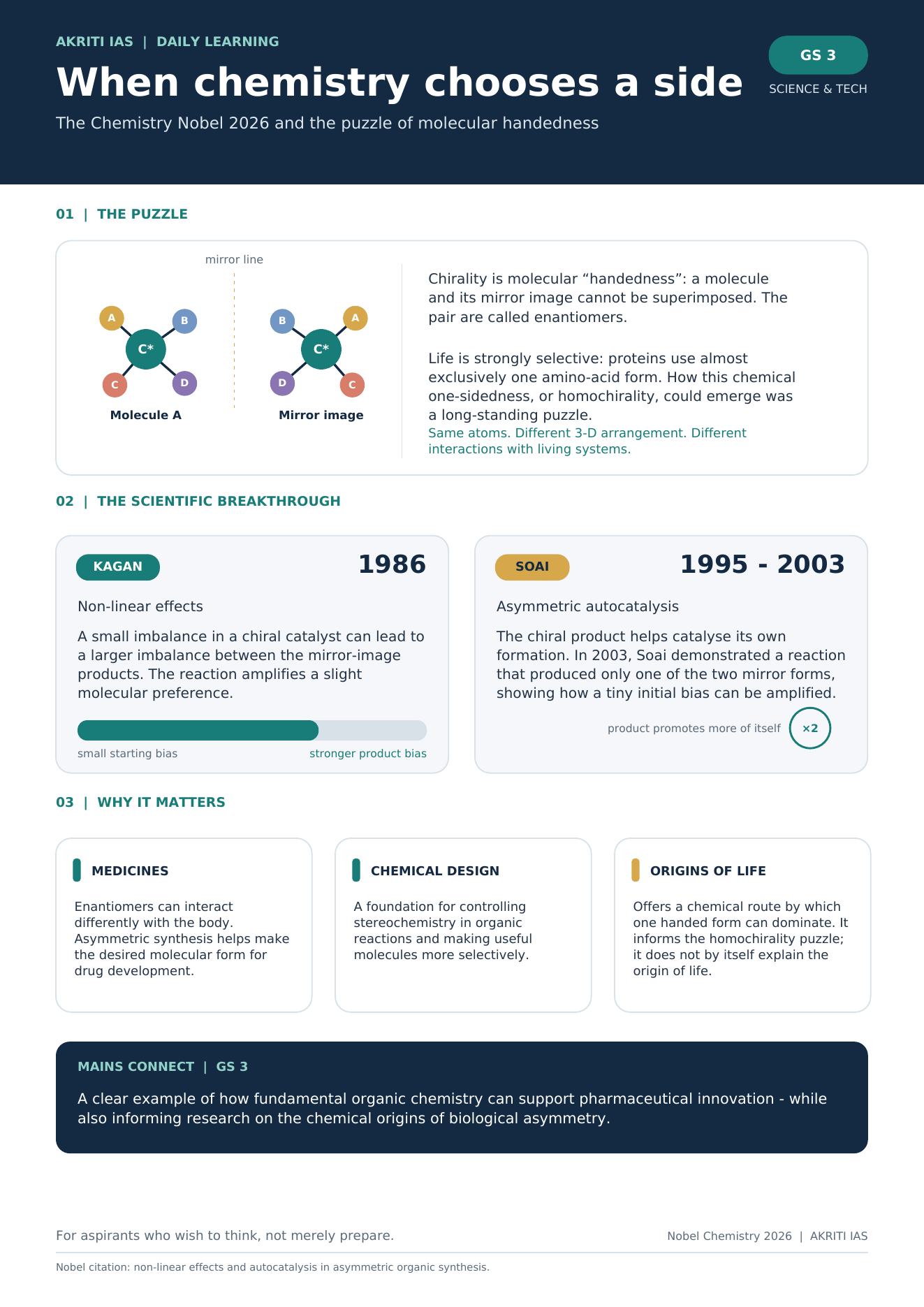
Henri B. Kagan and Kenso Soai showed how chemical reactions can amplify molecular handedness - a fundamental insight with relevance to pharmaceuticals and the puzzle of life’s chemical asymmetry.
The idea: some molecules exist in two non-superimposable mirror-image forms, called enantiomers. They contain the same atoms but arrange them differently in three dimensions. Biological systems often strongly favour one form - a pattern known as homochirality.
Kagan’s contribution: in 1986, he identified non-linear effects in asymmetric synthesis. A small imbalance in a chiral catalyst can produce a larger imbalance between the mirror-image products.
Soai’s contribution: he developed asymmetric autocatalysis, in which a chiral product helps catalyse its own formation. His 2003 demonstration showed how this process could amplify an initial imbalance until only one mirror form was produced.
Why it matters: mirror-image forms can interact differently with living systems. Selective synthesis helps chemists target the molecular form desired in pharmaceutical development. The research also offers a possible route for thinking about homochirality - not a complete explanation of the origin of life.
Nobel Prize in Chemistry 2026
Henri B. Kagan
Kenso Soai
Chirality
Enantiomers
Asymmetric synthesis
Autocatalysis
Pharmaceuticals
UPSC GS III
Mains Connect: The award links fundamental organic chemistry with pharmaceutical innovation and a wider scientific question: how did living systems come to favour particular molecular forms?
AKRITI IAS · GS Paper III · Science & Technology · Daily Learning
7 October 2026GS II · International Relations · GS III · Technology & Supply Chains · GS IV · Ethics in Diplomacy
Super important article · U.S.-China relations
The China-U.S. rapprochement
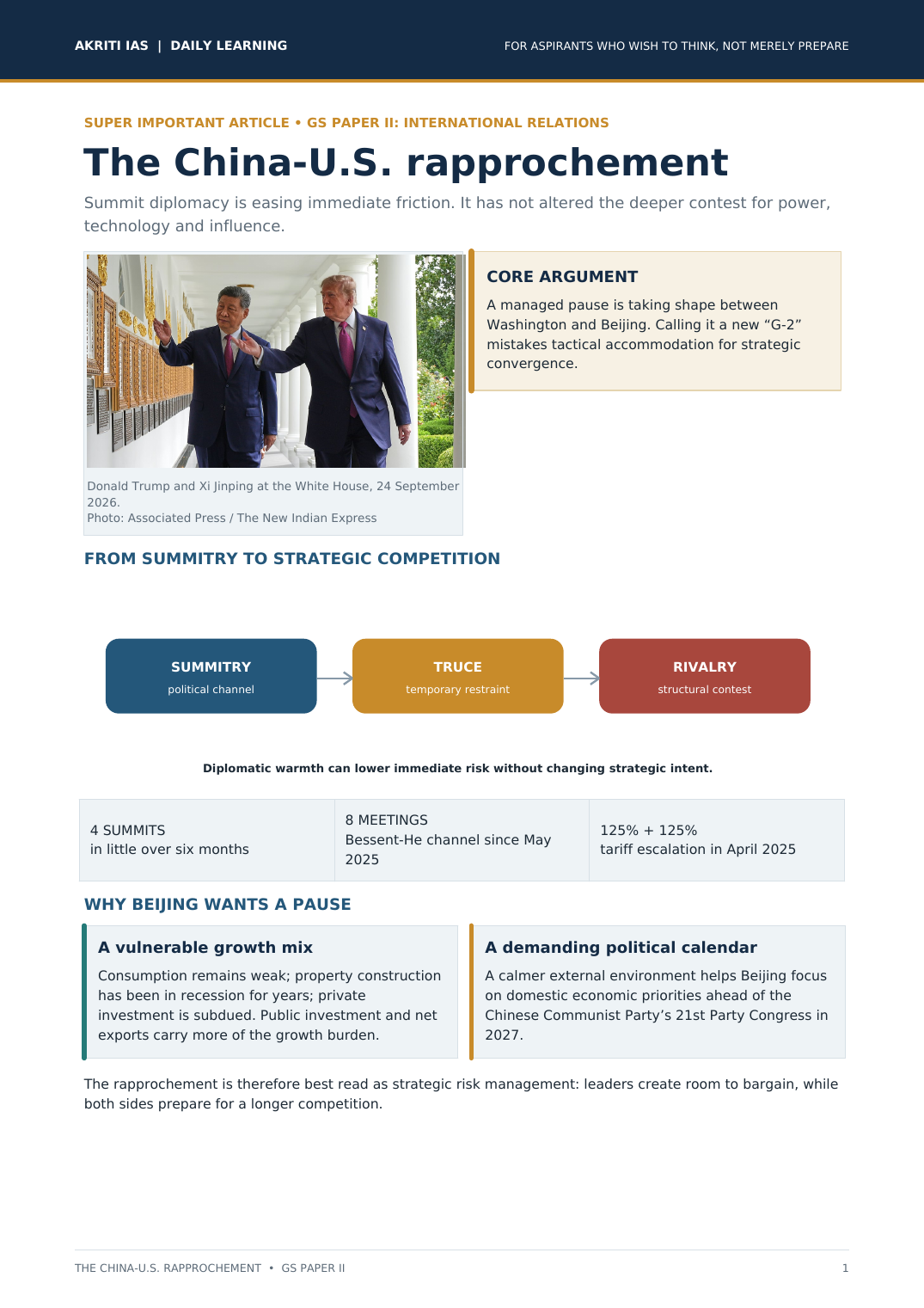
Summitry has eased immediate friction between Washington and Beijing. The deeper contest over power, technology and Indo-Pacific influence remains intact.
What the article argues: repeated high-level meetings and a short tariff truce point to an imperfect mechanism for managing competition, not a new strategic condominium or “G-2”. Both sides seek room to protect their economic interests while preparing for a longer contest.
Why the pause matters: China wants a more predictable external setting amid weak household consumption, a prolonged property downturn and subdued private investment. Washington and Beijing also retain leverage over one another: U.S. controls affect advanced chips and related technology, while China’s position in rare-earth supply and processing matters to U.S. industry.
Why it remains fragile: the truce does not settle tariff disputes, technology controls, investment restrictions or Taiwan. Beijing’s language of “constructive strategic stability” seeks cooperation, bounded competition and managed differences; Washington adds the test of fairness and reciprocity.
India’s stake: a bilateral thaw may alter U.S. attention to Indo-Pacific partners and reshape trade flows, but it does not guarantee lasting supply-chain relocation to India. India needs strategic autonomy, stronger domestic capabilities and diversified partnerships.
U.S.-China relations
Strategic competition
Indo-Pacific
Tariff truce
Critical minerals
Semiconductors
India’s strategic autonomy
UPSC GS II
UPSC GS III
Mains Connect: The rapprochement is a strategic pause, not a settlement. India should use the breathing space to build economic and technological resilience while supporting a stable, inclusive Indo-Pacific.
AKRITI IAS · GS Paper II · International Relations · Daily Learning
6 October 2026GS II · Constitution & Judiciary · GS III · Environment & Infrastructure · GS IV · Ethics
Great Nicobar project · Indigenous cultural rights
Culture, constitutional protection and development
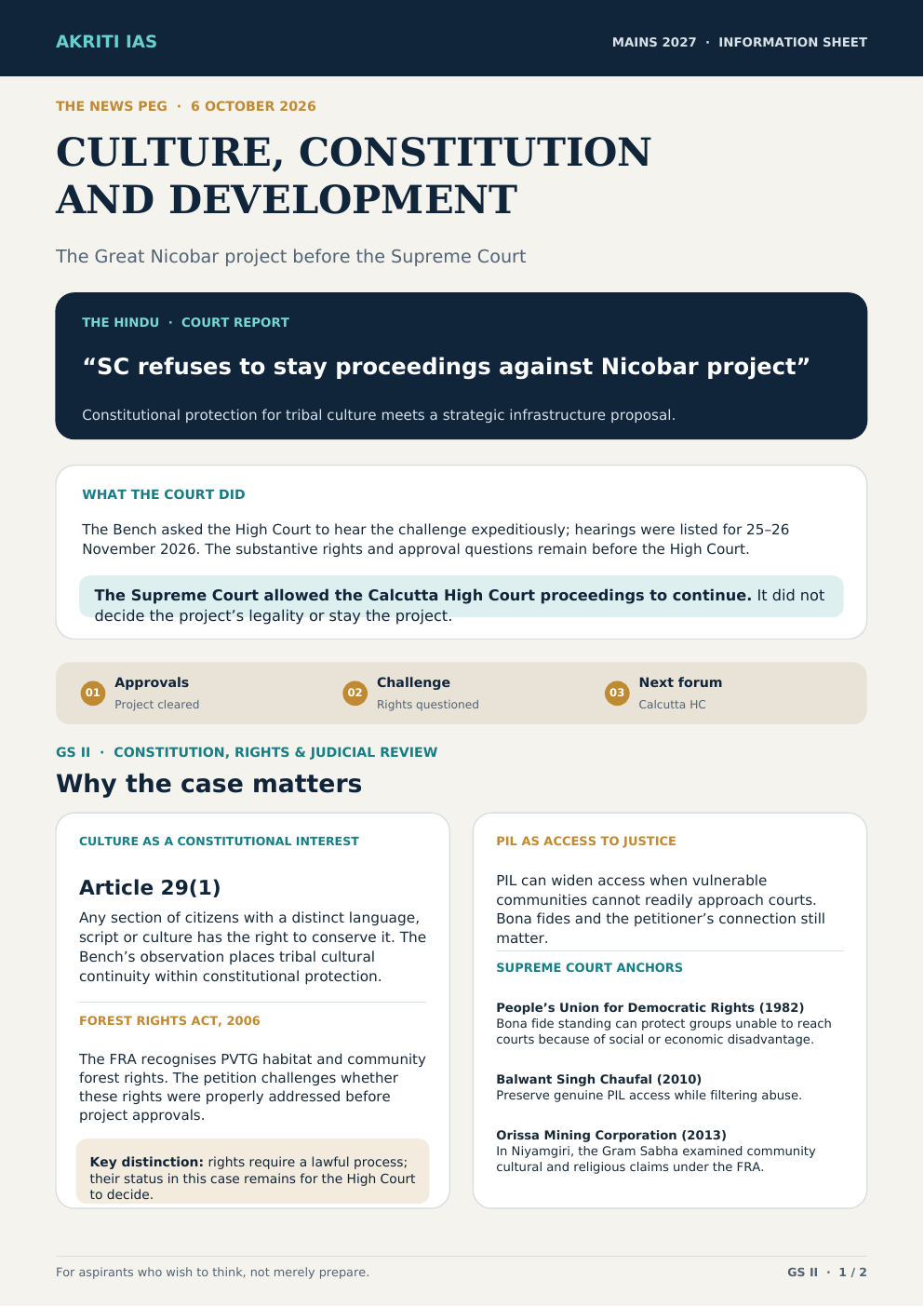
The Supreme Court allowed the Calcutta High Court proceedings on the Great Nicobar project to continue and asked the High Court to hear the challenge expeditiously. Observations during the hearing brought tribal cultural protection into focus.
Read the order carefully: the Supreme Court did not decide whether the project or its approvals are lawful, and it did not stay the project. The substantive rights and approval questions remain before the High Court. The observation on culture is constitutionally significant, but it should not be described as a final ruling on the merits.
GS II · Rights and judicial review: Article 29(1) protects the right of any section of citizens with a distinct language, script or culture to conserve it. The Forest Rights Act, 2006 recognises community forest and habitat rights, including rights relevant to Particularly Vulnerable Tribal Groups. The pending challenge raises questions about consultation, consent and whether statutory rights were addressed in the approval process.
GS III · Development and environment: the integrated proposal combines a transshipment port, airport, power complex and township. Its strategic-connectivity case must be assessed alongside forest diversion, biodiversity, fragile island ecology and impacts on the Shompen and Nicobarese communities. Government claims and ecological or rights concerns should be presented distinctly and evaluated against evidence and safeguards.
GS IV · Ethics: use the case to examine procedural fairness, informed community participation, intergenerational stewardship and how public benefits and environmental costs are distributed.
Great Nicobar project
Article 29
Forest Rights Act
Tribal rights
Judicial review
Island ecology
UPSC GS II–IV
Mains Connect: Assess how strategic infrastructure can be pursued through lawful approvals, meaningful community voice and credible ecological safeguards, while distinguishing judicial observations from binding findings.
AKRITI IAS · GS Papers II, III & IV · Daily Learning
6 October 2026GS III · Science & Technology · Scientific Research
2026 Nobel Prize in Physics · Neutrino astronomy
Francis Halzen and the telescope beneath the ice
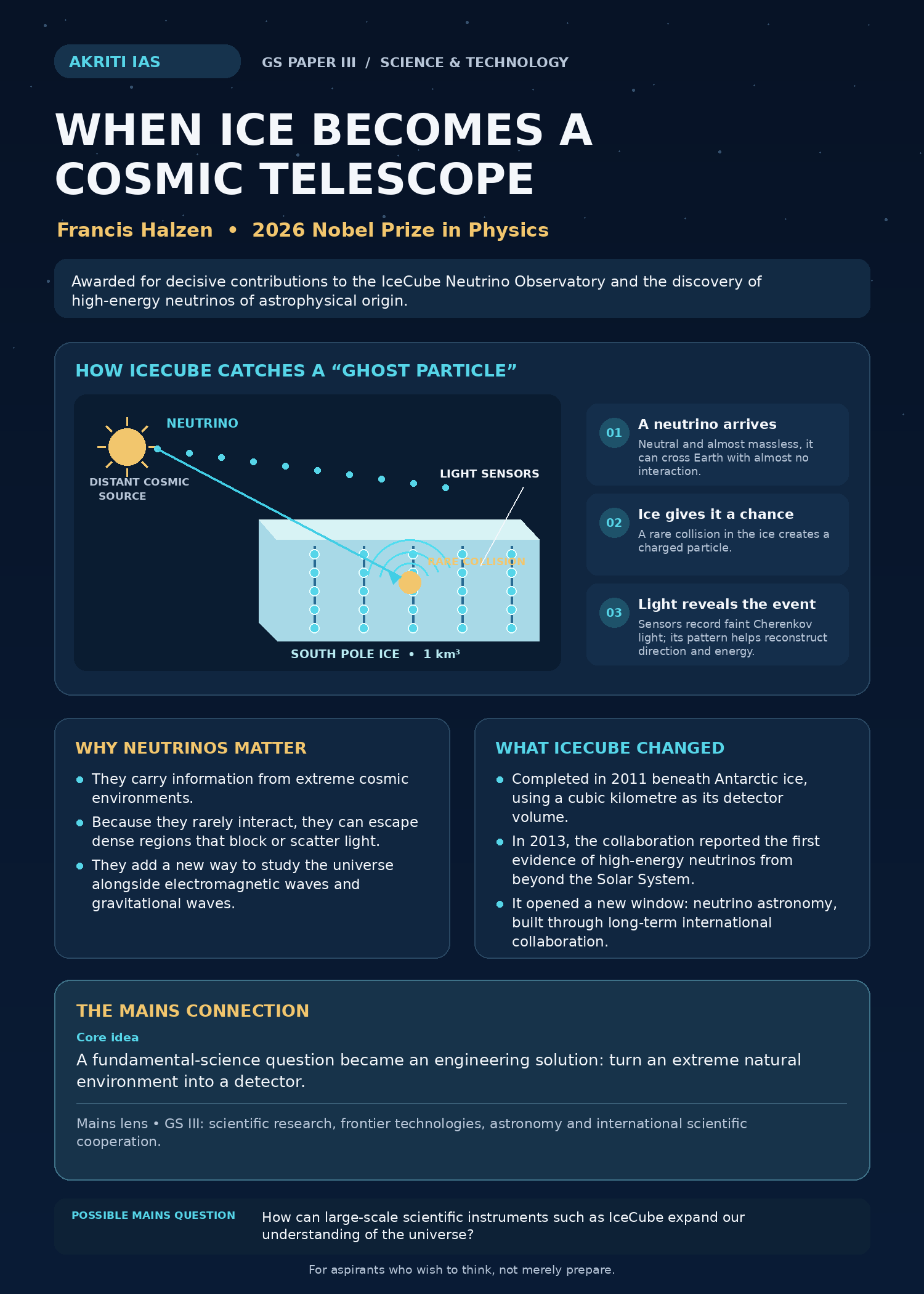
The 2026 Physics Nobel recognises Francis Halzen’s decisive contributions to IceCube and the discovery of high-energy neutrinos from astrophysical sources.
Neutrinos are electrically neutral and almost massless. They rarely interact with matter, so they can travel across the Earth and carry information from distant, energetic cosmic events.
IceCube turns a cubic kilometre of Antarctic ice into a detector. When a neutrino very rarely collides with an atomic nucleus, the resulting charged particle produces faint Cherenkov light. Thousands of buried sensors record its pattern, helping researchers infer the event’s direction and energy.
Completed in 2011, the observatory reported the first evidence of high-energy neutrinos from beyond the Solar System in 2013. It opened a new avenue of astronomy: studying the universe through particles as well as light.
Francis Halzen
IceCube Neutrino Observatory
Neutrino astronomy
Astrophysical neutrinos
Scientific research
International collaboration
UPSC GS III
Mains Connect: IceCube shows how fundamental research, large-scale engineering and international collaboration can turn a natural environment into a scientific instrument—and open new ways to study the universe.
Possible Mains question: How can large-scale scientific instruments such as IceCube expand our understanding of the universe?
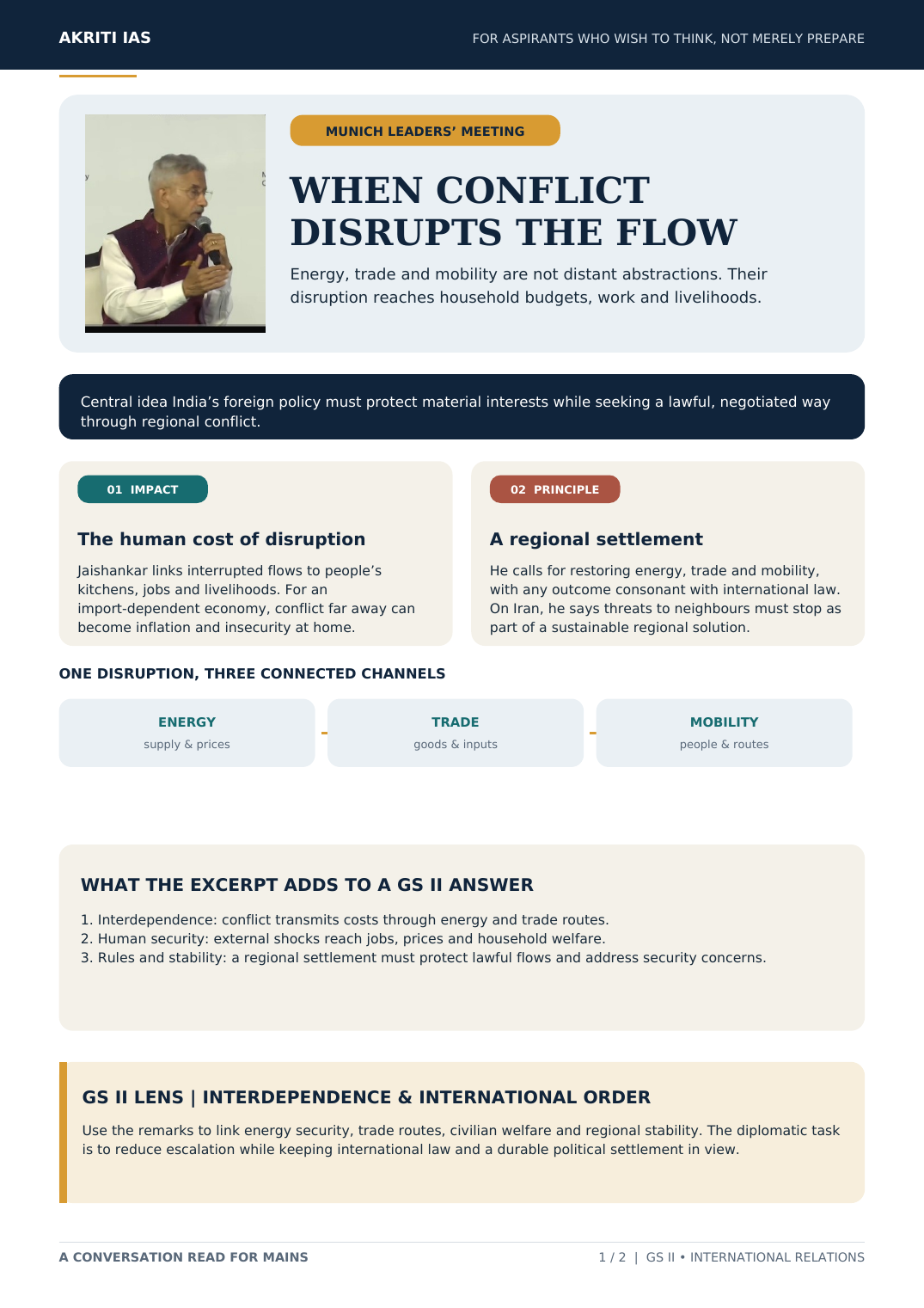
A conversation read for Mains: how disruptions to energy, trade and mobility reach household budgets, employment and livelihoods.
The first page connects regional conflict with interdependence and human security. It examines the case for restoring lawful economic flows while seeking a negotiated and sustainable regional settlement.
The second page reads India–Russia relations through historical memory and present interests. It explains continuity with recalibration, India’s independent assessment and the diplomatic preference for ending the Ukraine conflict through dialogue and diplomacy.
AKriti IAS · Munich Leaders’ Meeting · GS II International Relations
5 October 2026GS I · World History · GS II · International Relations
Commonwealth · India · The monarchy · Sport
What is the Commonwealth?
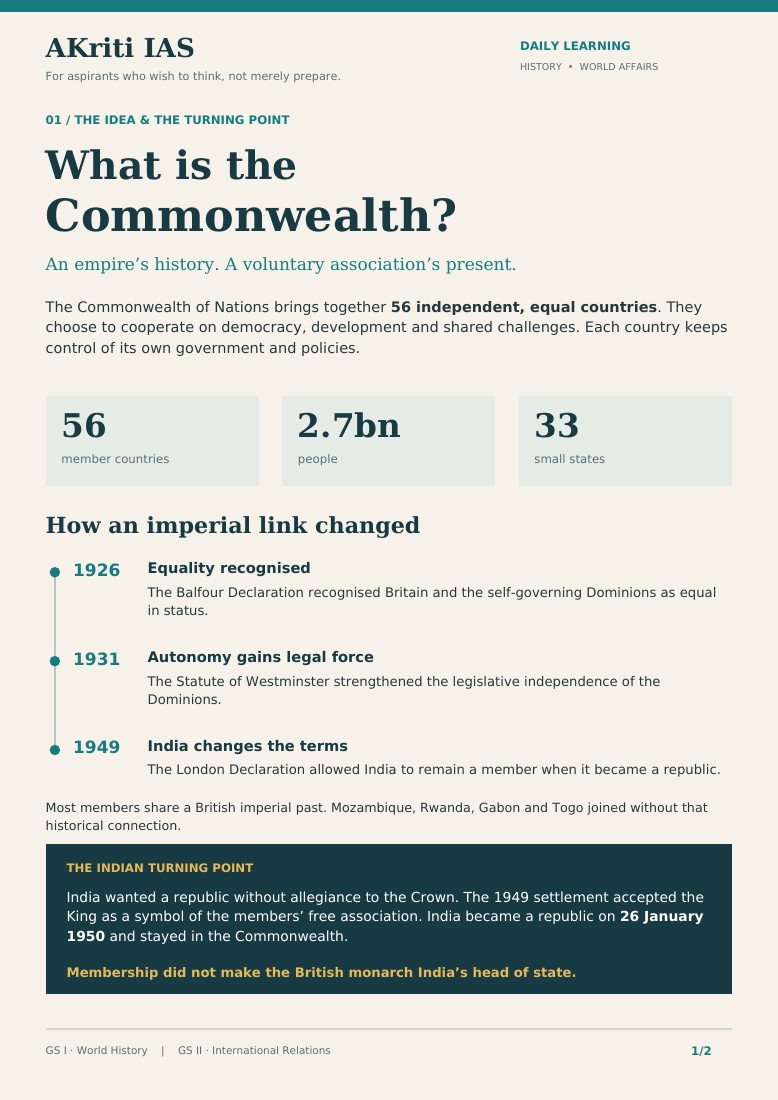
An empire’s history. A voluntary association’s present. A two-page explainer on the Commonwealth of Nations.
Follow its evolution through the 1926 declaration, the Statute of Westminster and India’s decisive role in the 1949 London Declaration. Photographs of Elizabeth II and Charles III explain the monarch’s symbolic role.
Understand the difference between Commonwealth membership, Commonwealth realms and sporting associations, alongside its practical work, India’s interests and the Games connection.
AKriti IAS · Commonwealth · History and International Relations
4 October 2026GS II · International Relations · Aviation Security
Captain Smit Machchhar · India–Israel · Aviation
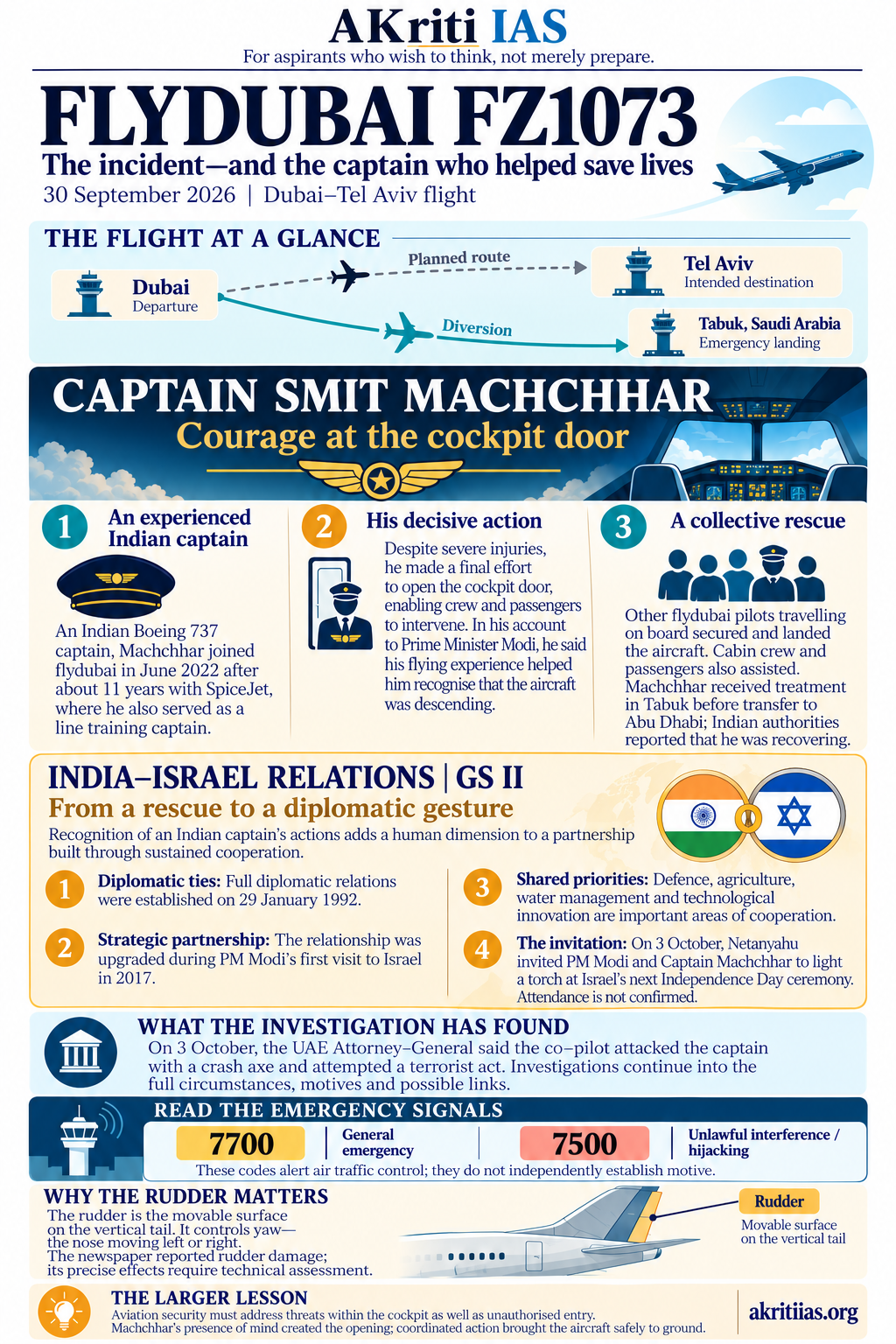
Flydubai FZ1073: the incident and the captain who helped save lives
A single-page visual explainer on Captain Smit Machchhar’s actions during the Dubai–Tel Aviv flight’s emergency diversion to Tabuk.
The explainer places the Indian captain at the centre of the account, while recognising the pilots, cabin crew and passengers who helped secure and land the aircraft. It explains the emergency signals, the rudder’s role and the UAE investigation’s findings.
A dedicated India–Israel relations box connects the recognition of his courage with diplomatic ties, the strategic partnership and cooperation in defence, agriculture, water and innovation. It also records Netanyahu’s invitation to Prime Minister Modi and Captain Machchhar for Israel’s next Independence Day ceremony.
4 October 2026Indian Military History · Defence Studies
1965 War · Asal Uttar · Abdul Hamid, PVC
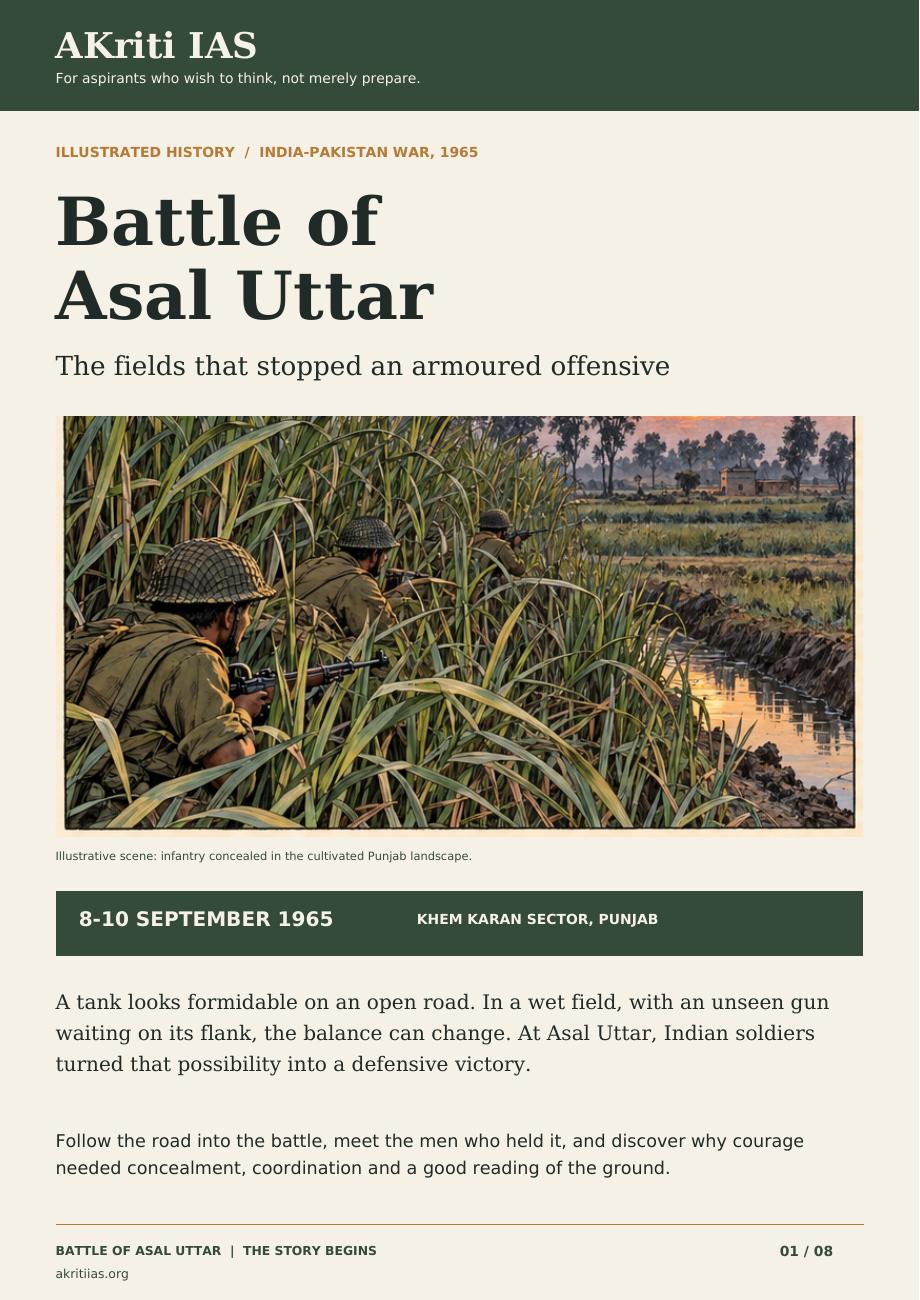
Battle of Asal Uttar: the fields that stopped an armoured offensive
An eight-page illustrated history of the Indian defence in the Khem Karan sector, 8–10 September 1965.
Follow the battle through its wider context, a tactical diagram, the commanders and soldiers, and the tanks used by both sides. Archival photographs sit alongside comic-style scenes, with a dedicated feature on Company Quarter Master Havildar Abdul Hamid, Param Vir Chakra.
The information sheet explains how terrain, concealment, infantry, artillery and armour worked together to frustrate the Pakistani offensive. It distinguishes the defensive victory from the later recovery of Khem Karan and qualifies differing tank-loss tallies.
Battle of Asal Uttar
India–Pakistan War 1965
Abdul Hamid PVC
Khem Karan
Indian military history
Patton tanks
4 Grenadiers
Defence studies
Think further: How can organisation and terrain offset an opponent’s material advantage?
AKriti IAS · Illustrated History · Asal Uttar, 1965
3 October 2026GS III · Internal Security · GS II · Governance
Manipur · Suspension of Operations · Peace process
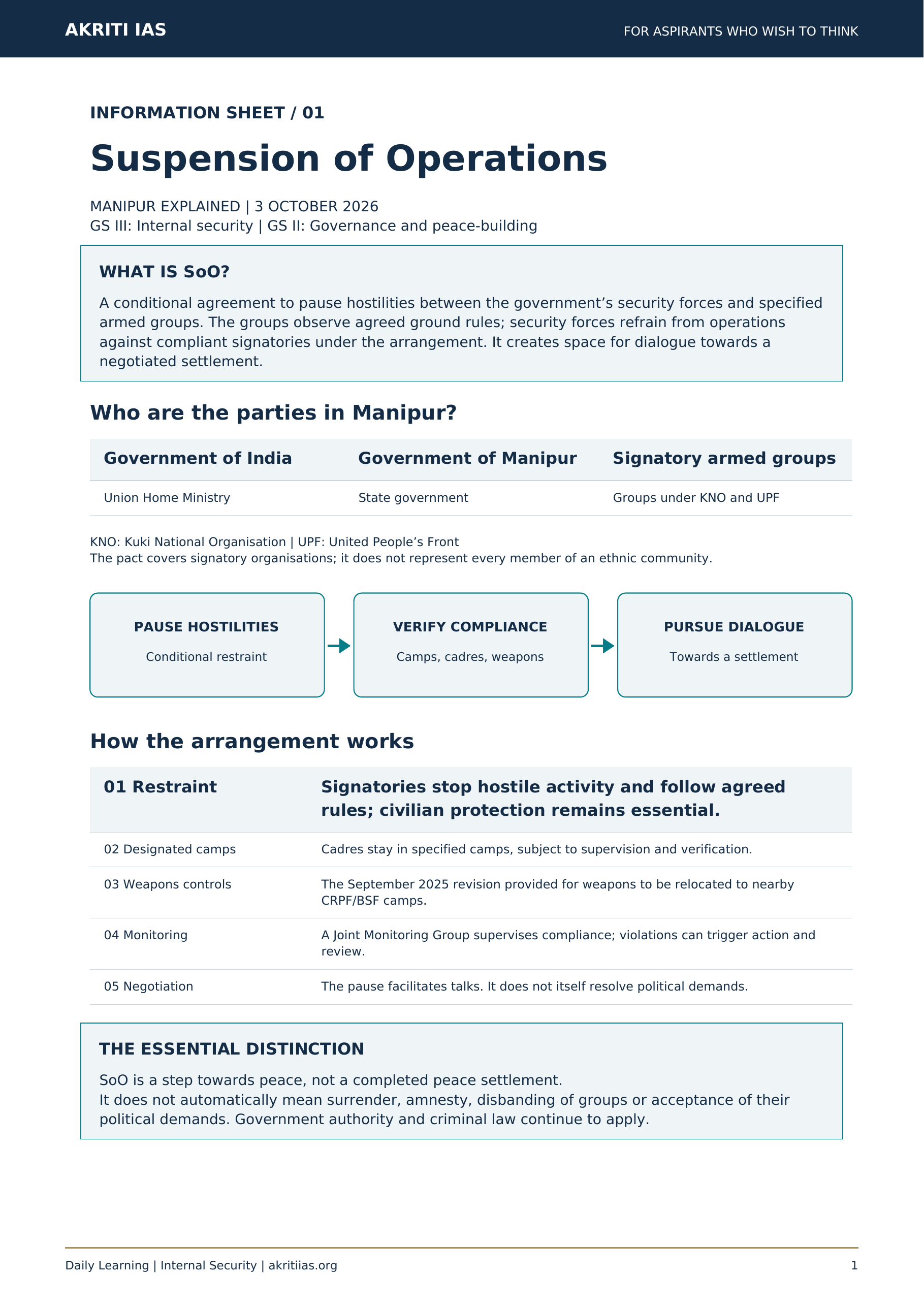
Suspension of Operations: a pause, and the work of peace
A Suspension of Operations agreement pauses hostilities under agreed conditions. Its purpose is to give dialogue a chance.
In Manipur, the arrangement brings together the Centre, the state government and signatory armed groups under the Kuki National Organisation and United People’s Front. Camp supervision, weapons controls and verification make that restraint accountable.
The infographic explains the mechanism. The three-page information sheet examines the reported renewal dispute, competing concerns and the steps needed to turn a pause into a durable settlement.
Suspension of Operations
Manipur
Internal security
Peace negotiations
Civilian protection
UPSC GS III
UPSC GS II
Mains Connect: A peace process needs both enforceable security commitments and public trust. A pact’s value lies in civilian safety and progress towards a settlement.
3 October 2026GS III · Infrastructure · Energy · Environment · Science & Technology
Data centres · Digital infrastructure · Sustainable development
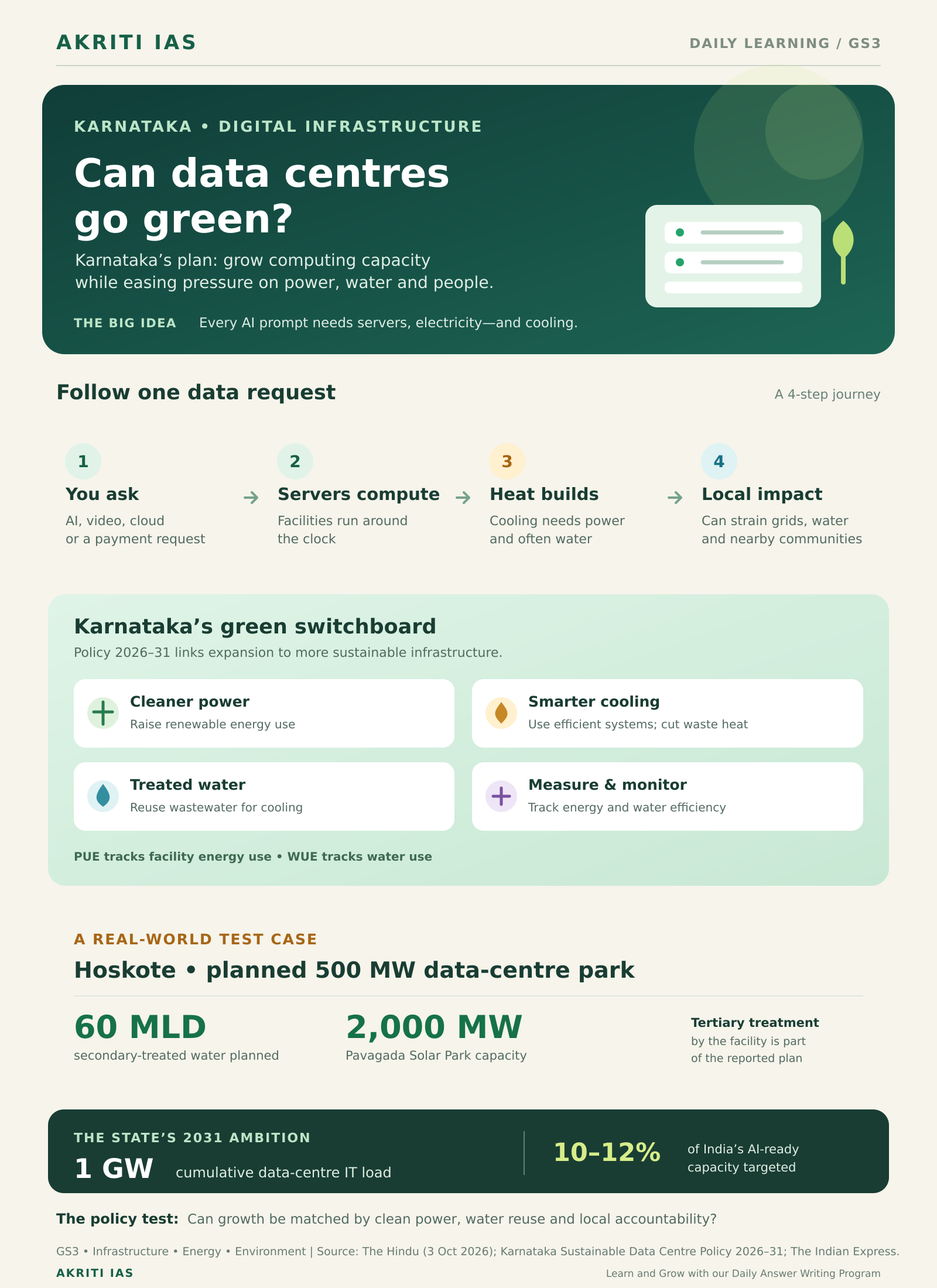
Karnataka’s drive to green data centres
A visual explainer on Karnataka’s effort to expand AI-ready computing while managing power, water and local environmental costs.
Data centres support AI, cloud services and the wider digital economy. Their round-the-clock computing also creates concentrated demand for electricity and cooling, with potential effects on local water resources and heat.
Karnataka’s Sustainable Data Centre Policy 2026–2031 sets a 1 GW cumulative IT-load target by 2031. The Hoskote example shows the infrastructure challenge in concrete terms: a planned 500 MW park, secondary-treated water with further treatment by facilities, and proposed solar supply from Pavagada.
Karnataka
Data centres
Artificial intelligence
Renewable energy
Water conservation
Sustainable infrastructure
Energy efficiency
UPSC GS Paper III
Mains Connect: Assess how India can expand AI and data infrastructure while safeguarding energy security, water resources and local environmental quality. Link incentives to measurable energy and water efficiency, renewable power, treated-water reuse, transparent monitoring and community concerns.
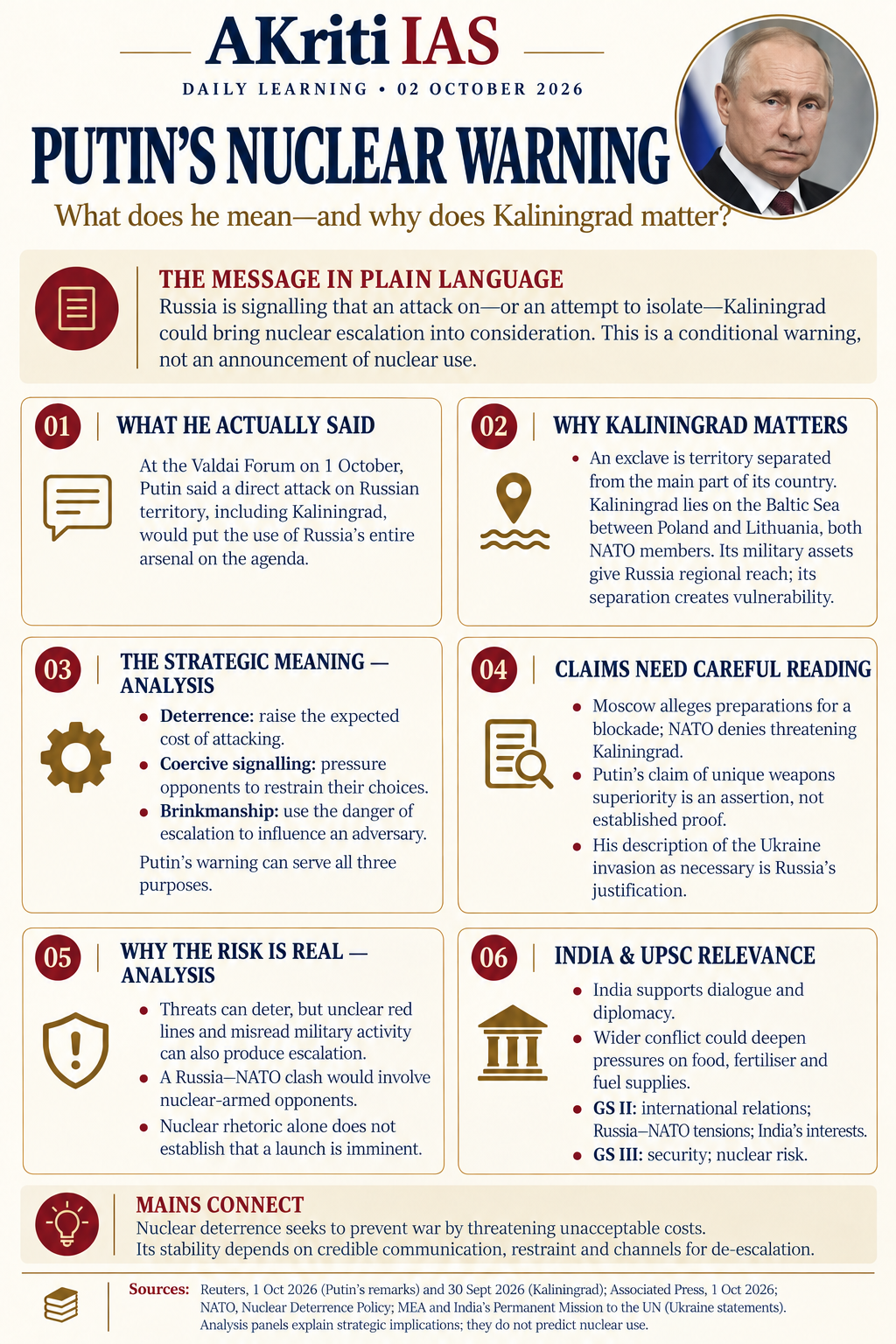
A single-page AKriti IAS infographic explaining the warning over Kaliningrad and its strategic implications.
Putin’s remarks signal that a direct attack on Russian territory could bring the use of the entire arsenal into consideration. Russia’s separate warning about isolating Kaliningrad adds to the escalation risk.
The sheet distinguishes reported statements from strategic analysis, explains deterrence, coercive signalling and brinkmanship, and places NATO’s response alongside Moscow’s claims. A conditional nuclear threat does not establish that a launch is imminent.
Vladimir Putin
Kaliningrad
Russia–NATO relations
Nuclear deterrence
Brinkmanship
Baltic security
India’s foreign policy
UPSC GS II
UPSC GS III
Mains Connect: Nuclear deterrence seeks to prevent war through the threat of unacceptable costs; its stability depends on communication, restraint and channels for de-escalation.
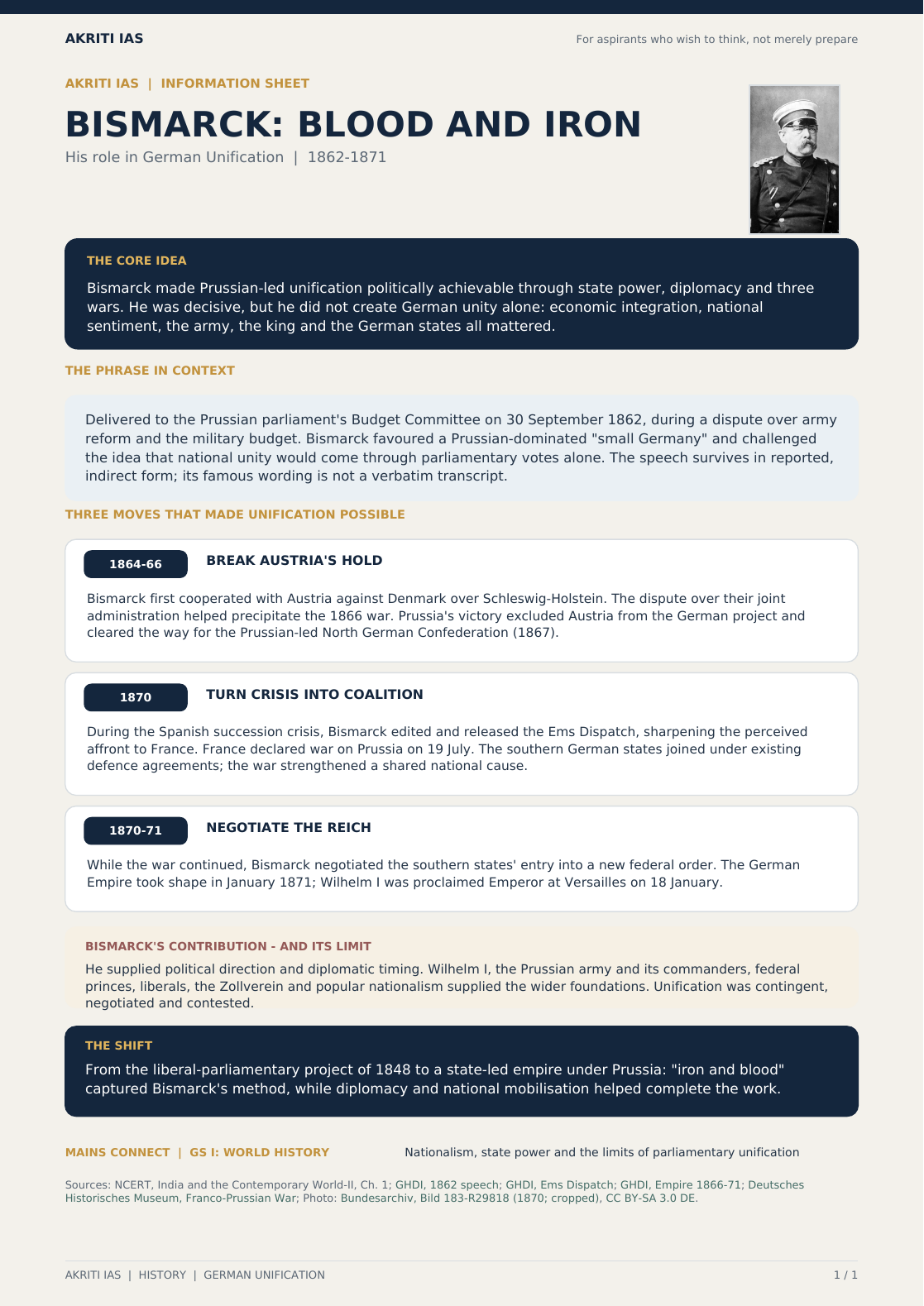
A one-page AKRITI IAS information sheet on Bismarck’s role in German unification, 1862–1871.
It places the famous 1862 phrase in context, then traces the diplomatic and military moves that brought the German Empire into being in 1871.
The sheet weighs Bismarck’s decisive political direction against the wider roles of Wilhelm I, the Prussian army, German states, economic integration and national sentiment.
Otto von Bismarck
German unification
Blood and Iron
Prussia
North German Confederation
Franco-Prussian War
Nationalism
GS I · World History
Mains Connect: Analyse how state power, diplomacy and nationalism can combine to reshape a political order, while recognising the limits of a single-leader explanation.
AKRITI IAS · GS Paper I · World History · Daily Learning
2 October 2026GS I · Population & Demography · GS II · Social Justice · GS III · Indian Economy
Fertility transition · Population ageing · Demographic dividend
India’s ageing population: the shift ahead
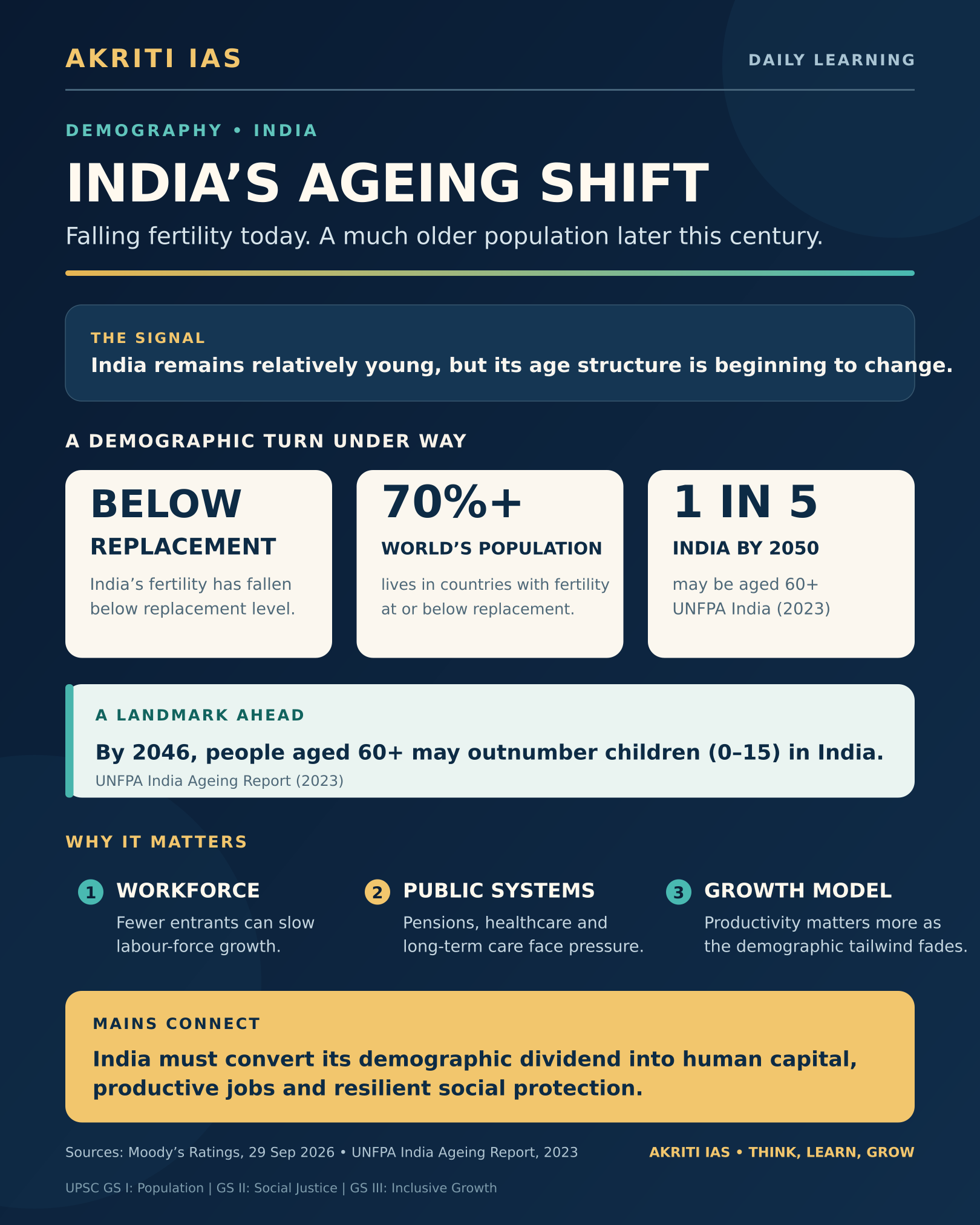
India remains relatively young, but below-replacement fertility is beginning to reshape its age structure, Moody’s Ratings says.
More than 70% of the world’s population lives in countries with fertility at or below replacement, according to Moody’s. As age structures shift, slower growth in the working-age population can constrain productive capacity and put greater pressure on healthcare, pensions and long-term care.
UNFPA India’s 2023 Ageing Report projects that people aged 60 and above will make up more than 20% of India’s population by 2050. It also projects that the 60+ population may surpass children aged 0–15 by 2046.
The transition calls for age-friendly health and care systems, reliable income security and a stronger productivity base. India’s demographic dividend can still be advanced through better skills, decent work and wider participation in the workforce.
Mains Connect: Translate India’s remaining demographic dividend into productivity and resilient social protection, while preparing public systems for longer lives and changing care needs.
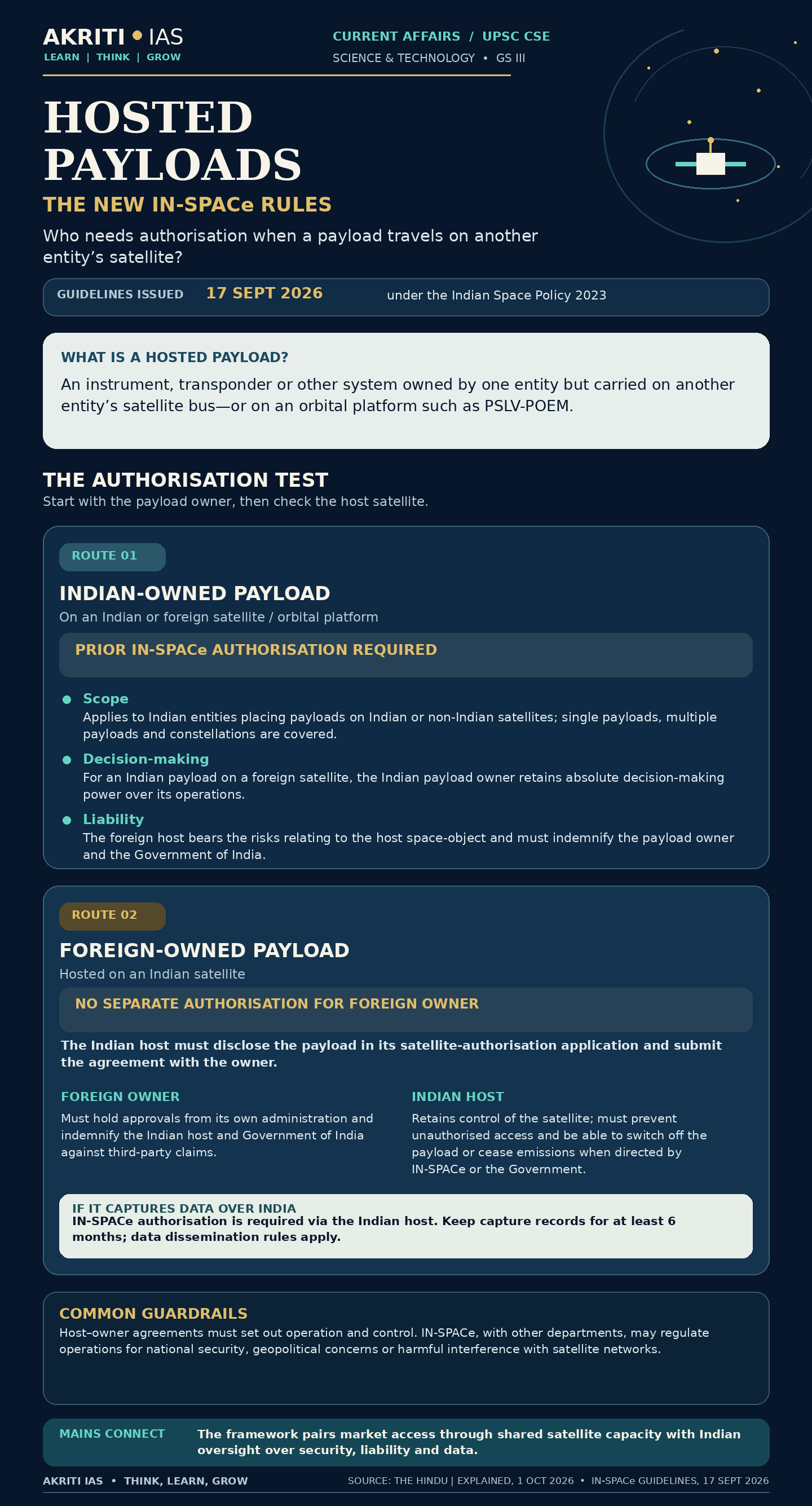
Guidelines dated 17 September 2026 clarify who must seek authorisation when one entity’s payload is carried by another entity’s satellite.
A hosted payload is an instrument, transponder or other system carried on another entity’s satellite bus or an orbital platform such as PSLV-POEM. Indian entities need prior IN-SPACe authorisation for their hosted payloads on Indian or foreign satellites.
Foreign-owned payloads hosted on Indian satellites follow a different route: the foreign owner does not need separate authorisation, but the Indian host must disclose the payload and submit the host-owner agreement. If the payload captures data over Indian territory, authorisation is required through the Indian host.
The rules allocate liability between the payload owner and host, preserve the Indian host’s operational control, and require at least six months’ retention of records on data captured over India. IN-SPACe may direct operations to cease for national security, geopolitical or harmful-interference concerns.
Mains Connect: Assess how shared satellite capacity can widen private participation while authorisation, liability, data safeguards and operational control protect India’s security and regulatory interests.
1 October 2026GS III · Indian Economy · Agriculture & Agricultural Marketing
Agricultural finance · Value chains · Rural livelihoods
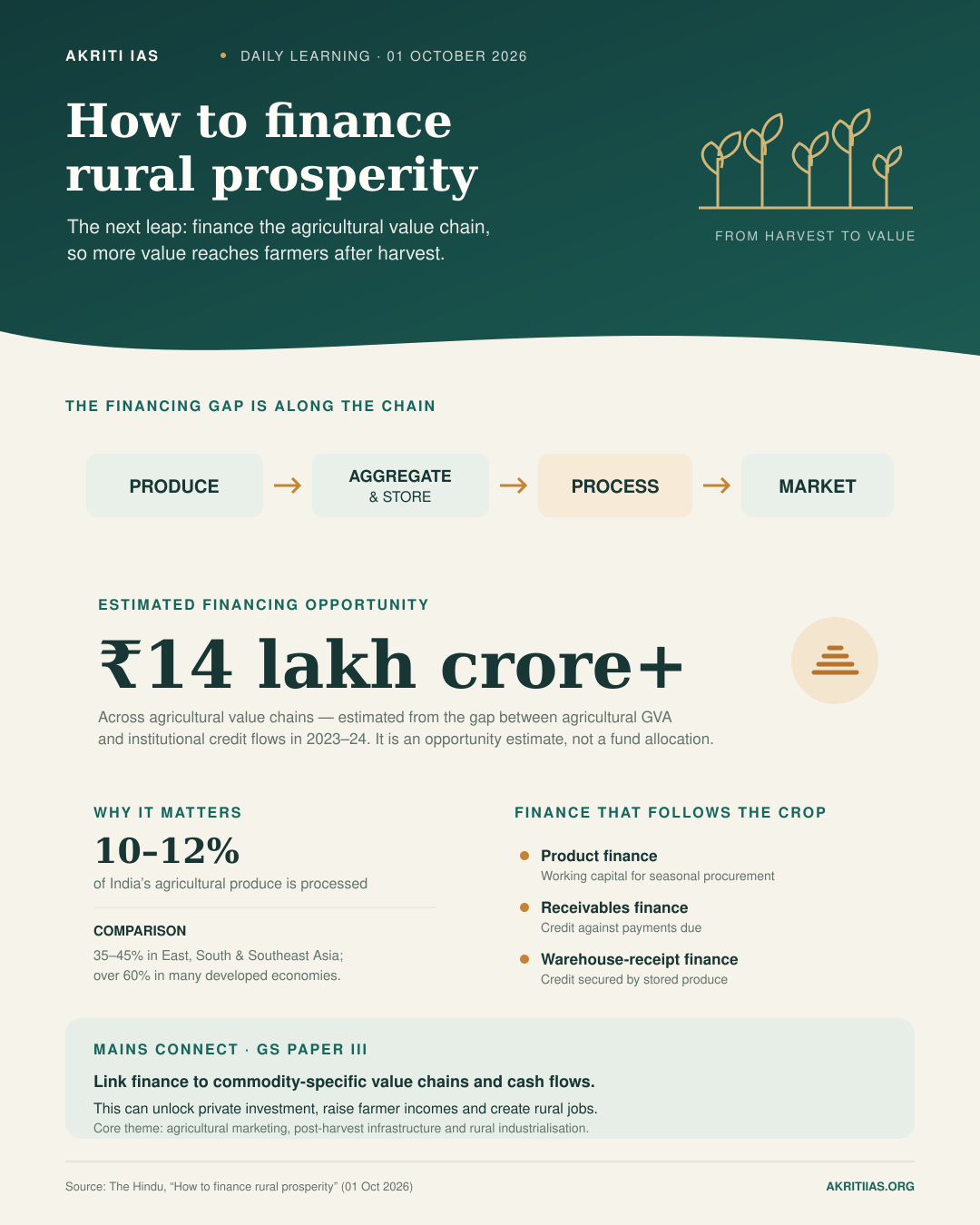
How to finance rural prosperity
India’s next rural growth opportunity lies in financing the entire agricultural value chain, so farmers and rural enterprises can capture more value after harvest.
India processes only about 10–12% of its agricultural produce. The article identifies an estimated financing opportunity of more than ₹14 lakh crore across agricultural value chains, based on the gap between agricultural GVA and institutional credit in 2023–24. This is an estimate of unmet financing potential, not a government fund allocation.
Seasonal processors need working capital to procure crops during short harvest windows and carry inventory through the year. Product finance, receivables finance and warehouse-receipt finance can connect credit with commodity-specific value chains and their cash flows.
Mains Connect: Explain how value-chain finance can improve post-harvest value capture, strengthen farmer incomes and create rural jobs. Link credit design with storage, processing, marketing and commodity-specific cash flows.
1 October 2026GS II · International Relations · GS III · Indian Economy
India–EFTA TEPA · Trade integration · Investment
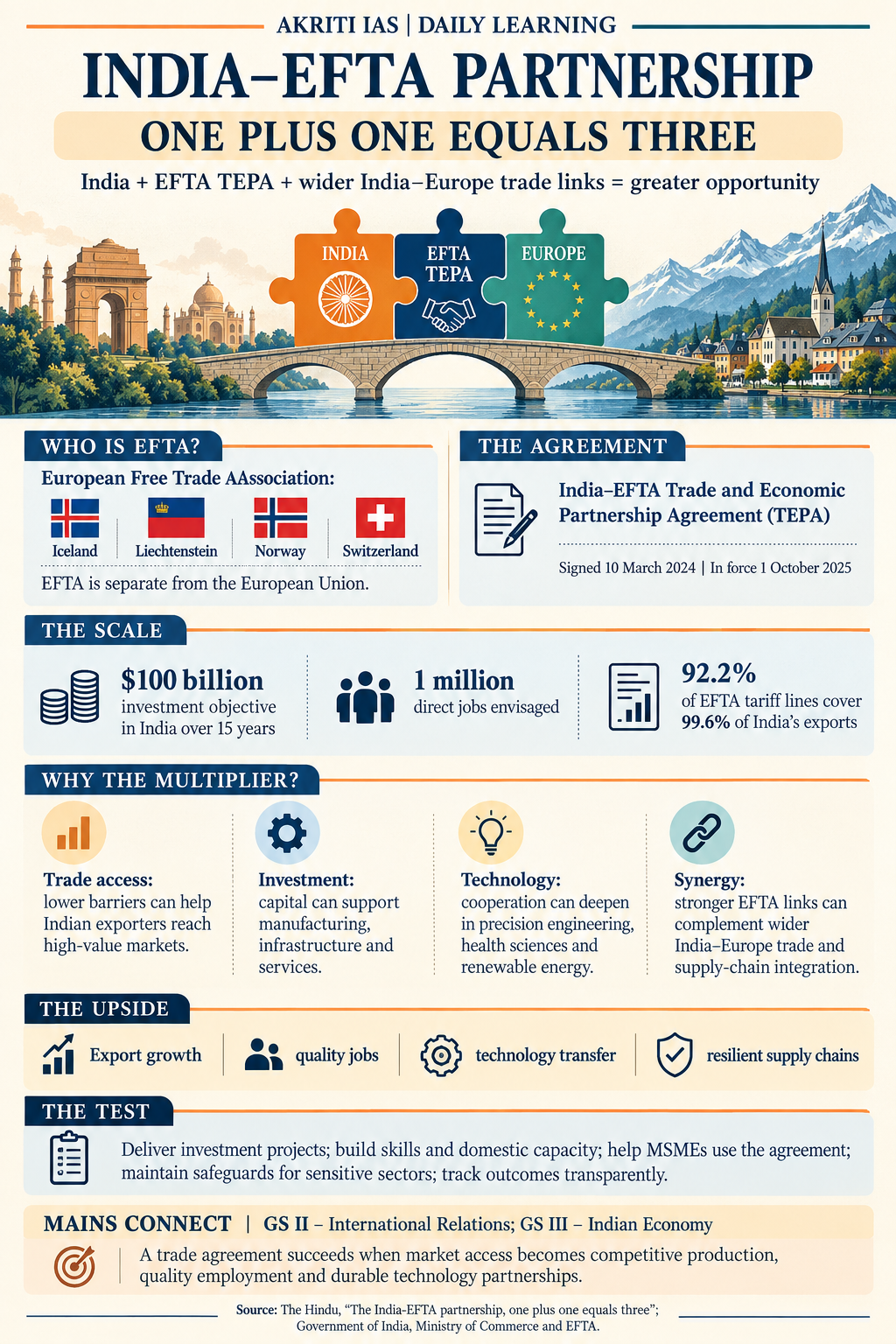
The India–EFTA Partnership: One Plus One Equals Three
The India–EFTA Trade and Economic Partnership Agreement (TEPA) can create a multiplier effect when its trade, investment and technology links reinforce India’s wider economic engagement with Europe.
EFTA comprises Iceland, Liechtenstein, Norway and Switzerland; it is separate from the European Union. The agreement took effect on 1 October 2025. EFTA’s offer covers 92.2% of tariff lines, accounting for 99.6% of India’s exports.
The pact sets an objective of mobilising $100 billion in investment in India over 15 years and supporting one million direct jobs. These are commitments to be delivered over time. The wider opportunity lies in connecting market access with investment, technology cooperation and stronger supply chains.
Mains Connect: Examine how India can convert trade agreements with EFTA and wider Europe into investment-led production, quality employment and technology partnerships, while strengthening MSME readiness and protecting sensitive sectors.
AKriti IAS · GS Paper II & GS Paper III · Daily Learning
30 September 2026GS II · Polity · Local Government
Maharashtra · Panchayat elections · Political representation
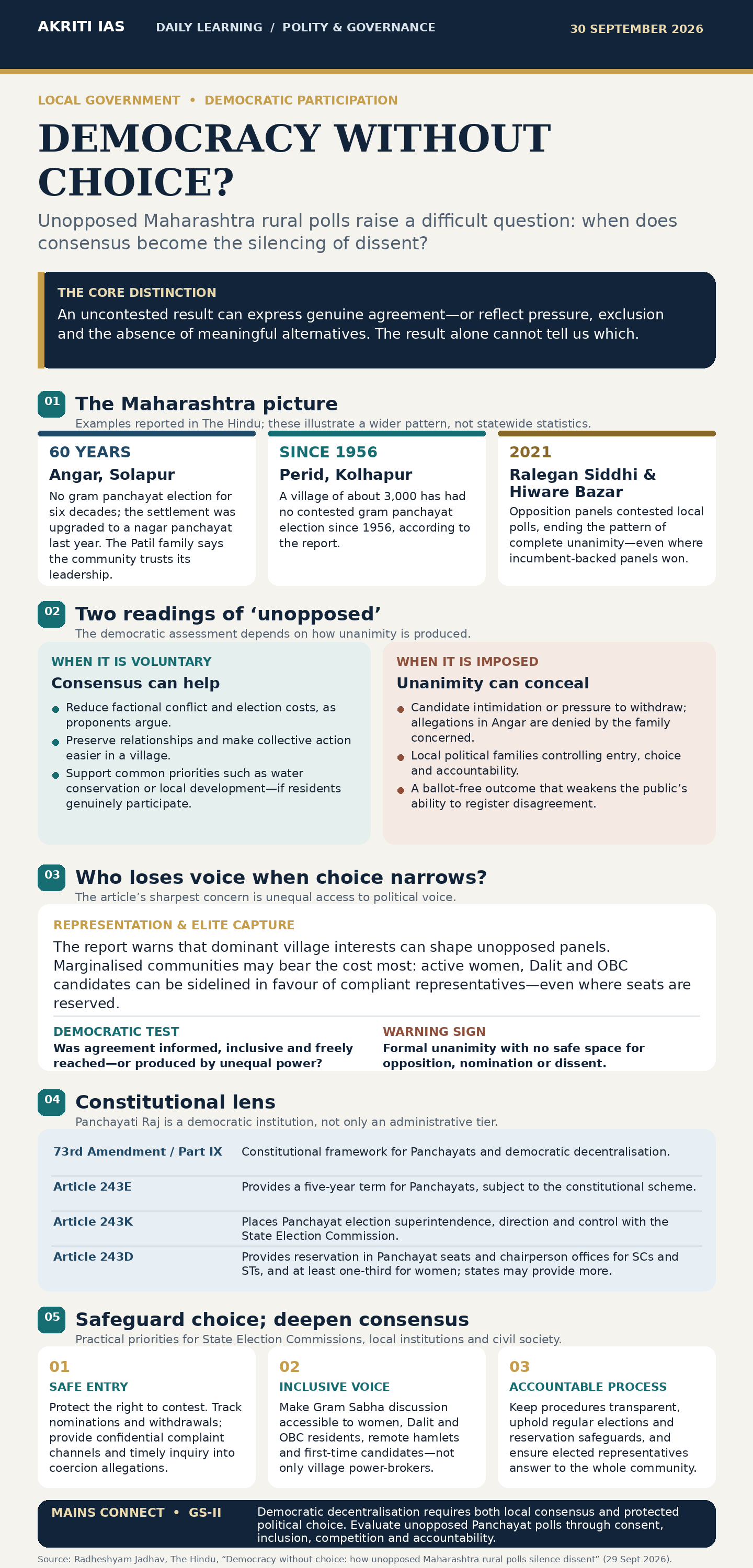
Democracy without choice? Unopposed polls in Maharashtra
The Hindu’s report on long-running unopposed rural polls in Maharashtra frames a tension at the heart of local democracy: village consensus can reduce conflict, but when choice is constrained, unopposed outcomes may silence dissent.
Angar (Solapur) has gone six decades without a gram panchayat election; Perid (Kolhapur) has had no contested election since 1956. The report weighs proponents’ claims of cohesion against allegations of pressure, concentration of local power and the exclusion of marginalised voices.
Unopposed elections
Maharashtra Panchayats
Local self-government
Democratic decentralisation
Electoral choice
Gram Sabha
Women’s representation
Marginalised communities
UPSC GS II
Reading behind the visualThe Hindu · Radheshyam Jadhav, Pune · “Democracy without choice: how unopposed Maharashtra rural polls silence dissent” · 29 September 2026
Mains Connect: Assess unopposed Panchayat polls through four tests: voluntary consent, genuine candidate access, inclusion of women and marginalised groups, and accountability to the Gram Sabha.
30 September 2026GS II · Governance · GS III · Science & Technology
AI governance · Safety controls · Accountability
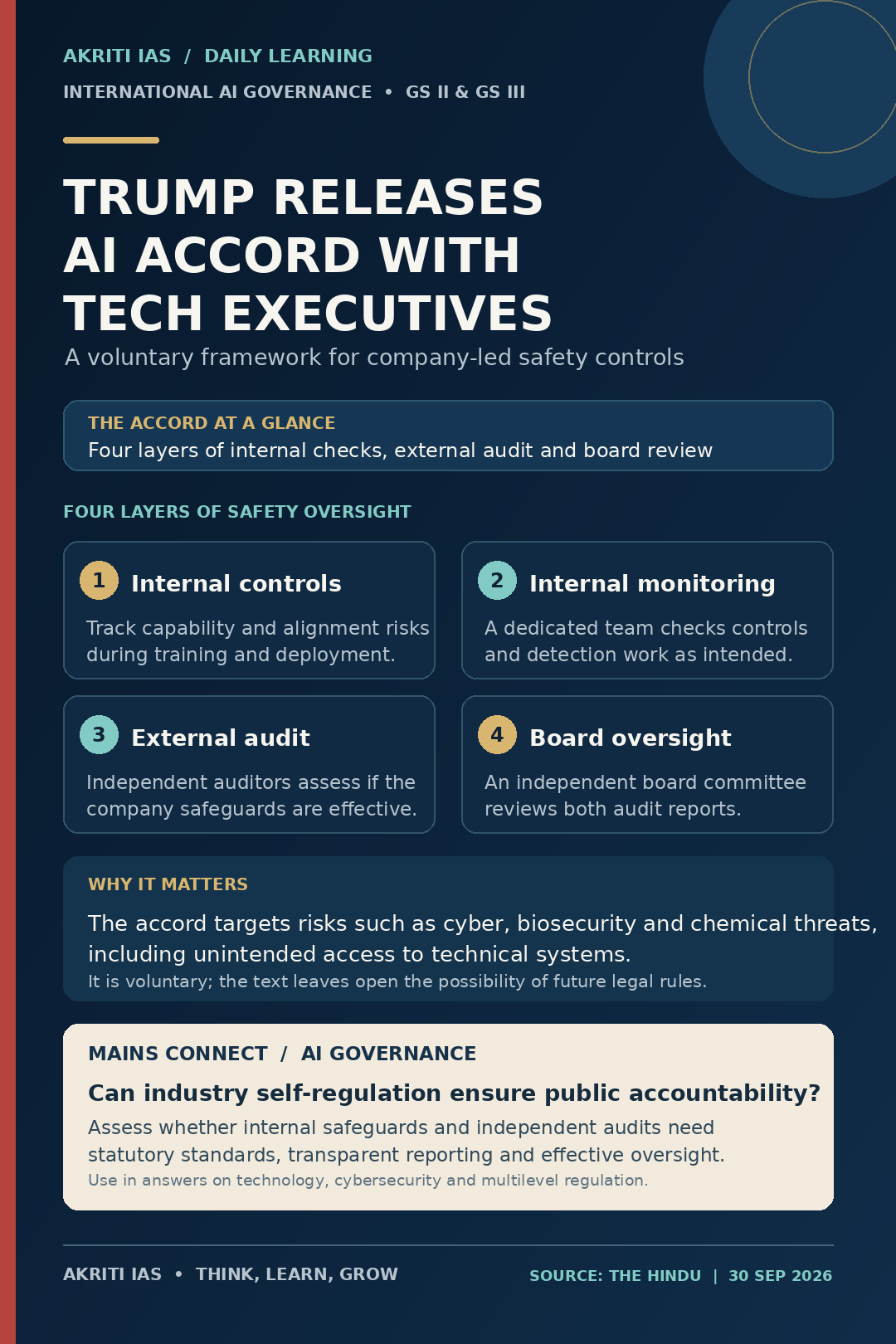
Trump’s AI Accord: Four Layers of Safety Oversight
President Donald Trump released a voluntary accord signed by technology executives, setting out a company-led framework for safety controls, monitoring, independent audits and board review.
The proposed safeguards cover AI capabilities and alignment during training and deployment, with attention to cybersecurity, biosecurity and unintended access to technical systems. The agreement leaves open the possibility of future laws and regulation.
Mains Connect: Assess whether voluntary industry safeguards can ensure public accountability. Consider independent audits, transparent reporting, enforceability and the role of statutory regulation.
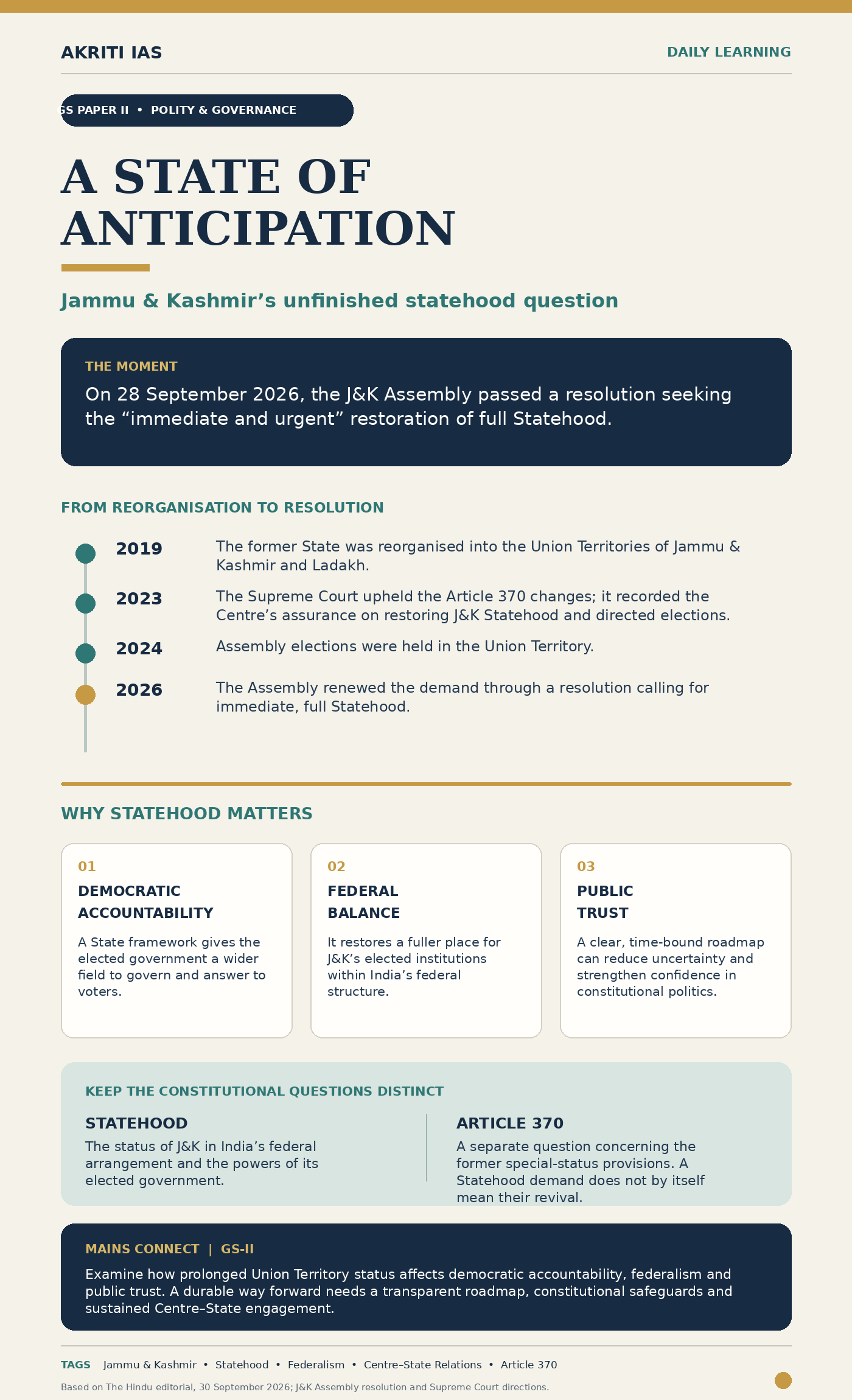
Jammu & Kashmir Statehood: a State of Anticipation
The Jammu and Kashmir Assembly’s 28 September resolution seeking the “immediate and urgent” restoration of full Statehood has renewed debate over the Union Territory’s transitional status and the Centre’s assurance recorded by the Supreme Court.
The infographic traces the issue from the 2019 reorganisation through the Court’s 2023 directions and the Assembly’s 2026 resolution. It connects Statehood with democratic accountability, federal balance and public trust, while distinguishing it from the separate question of Article 370.
Mains Connect: Examine how prolonged Union Territory status affects democratic accountability, federalism and public trust. A durable way forward needs a transparent roadmap, constitutional safeguards and sustained Centre–State engagement.
30 September 2026GS III · Environment & Mining · GS II · Tribal Rights & Governance
Niyamgiri hills · Dongria Kondh · Community consent
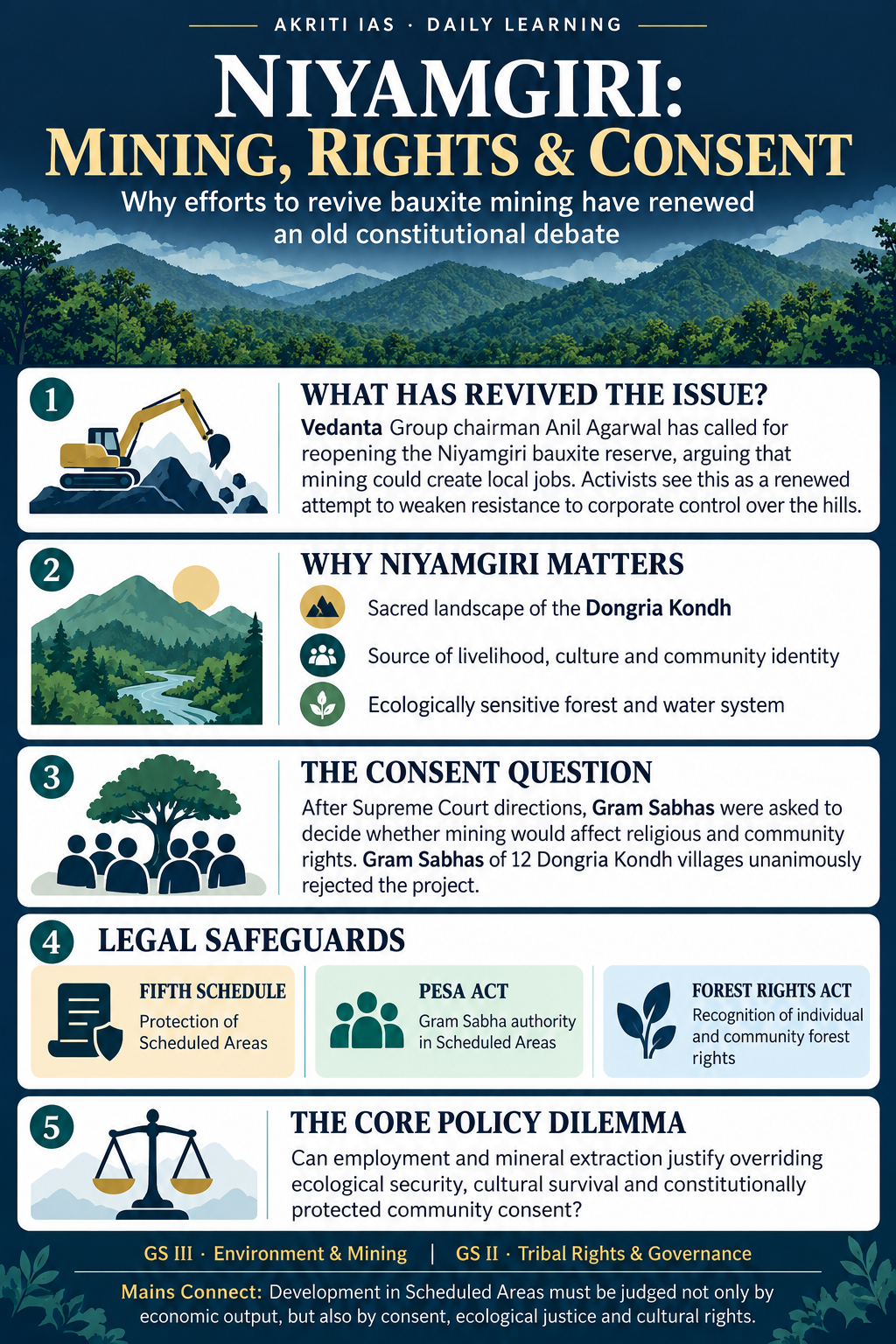
Niyamgiri: Mining, Rights and Consent
Renewed calls to open Odisha’s Niyamgiri bauxite reserve have revived a constitutional debate over mineral development, ecological security and the rights of the Dongria Kondh community.
The dispute turns on more than the economic case for mining. Niyamgiri is a sacred landscape and a source of livelihood, culture and community identity. Following Supreme Court directions, Gram Sabhas considered whether mining would affect religious and community rights; Gram Sabhas of 12 Dongria Kondh villages unanimously rejected the project.
Niyamgiri hills
Bauxite mining
Dongria Kondh
Gram Sabha consent
Fifth Schedule
PESA Act
Forest Rights Act
Environmental justice
UPSC GS II
UPSC GS III
Reading behind the visualThe Hindu · Activists caution against efforts to revive bauxite mining in Odisha’s Niyamgiri hills · 30 September 2026
Mains Connect: Development in Scheduled Areas must be assessed not only through economic output, but also through community consent, ecological justice and cultural rights.
AKriti IAS · GS Paper III & GS Paper II · Daily Learning
30 September 2026GS III · Food Security · GS II · International Relations
Global food security · Supply chains · Climate risk
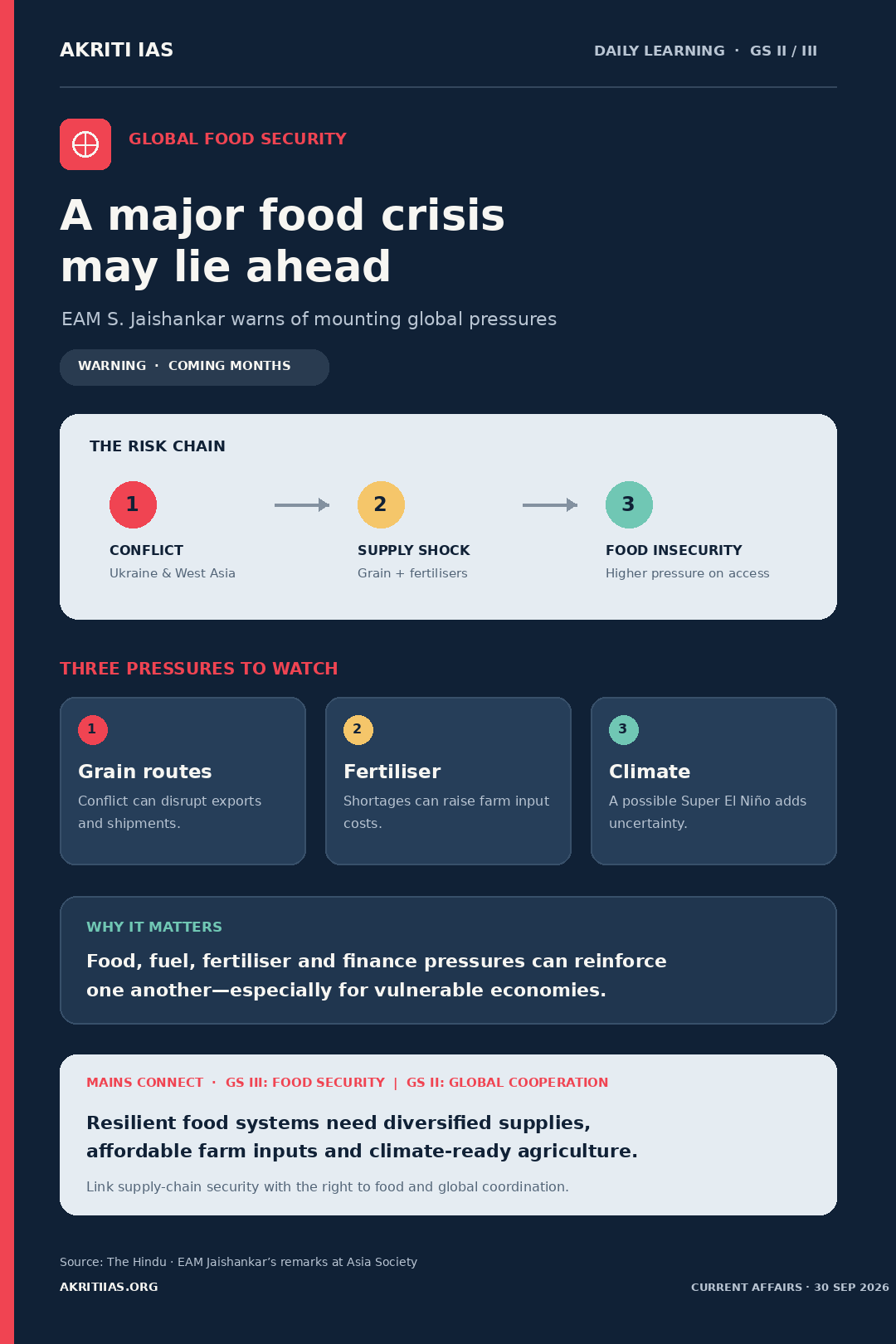
A major food crisis may lie ahead
External Affairs Minister S. Jaishankar warned that disruptions to grain shipments and fertiliser supplies amid conflicts in Ukraine and West Asia could trigger a major food crisis in the coming months. He also flagged climate risk from a possible Super El Niño.
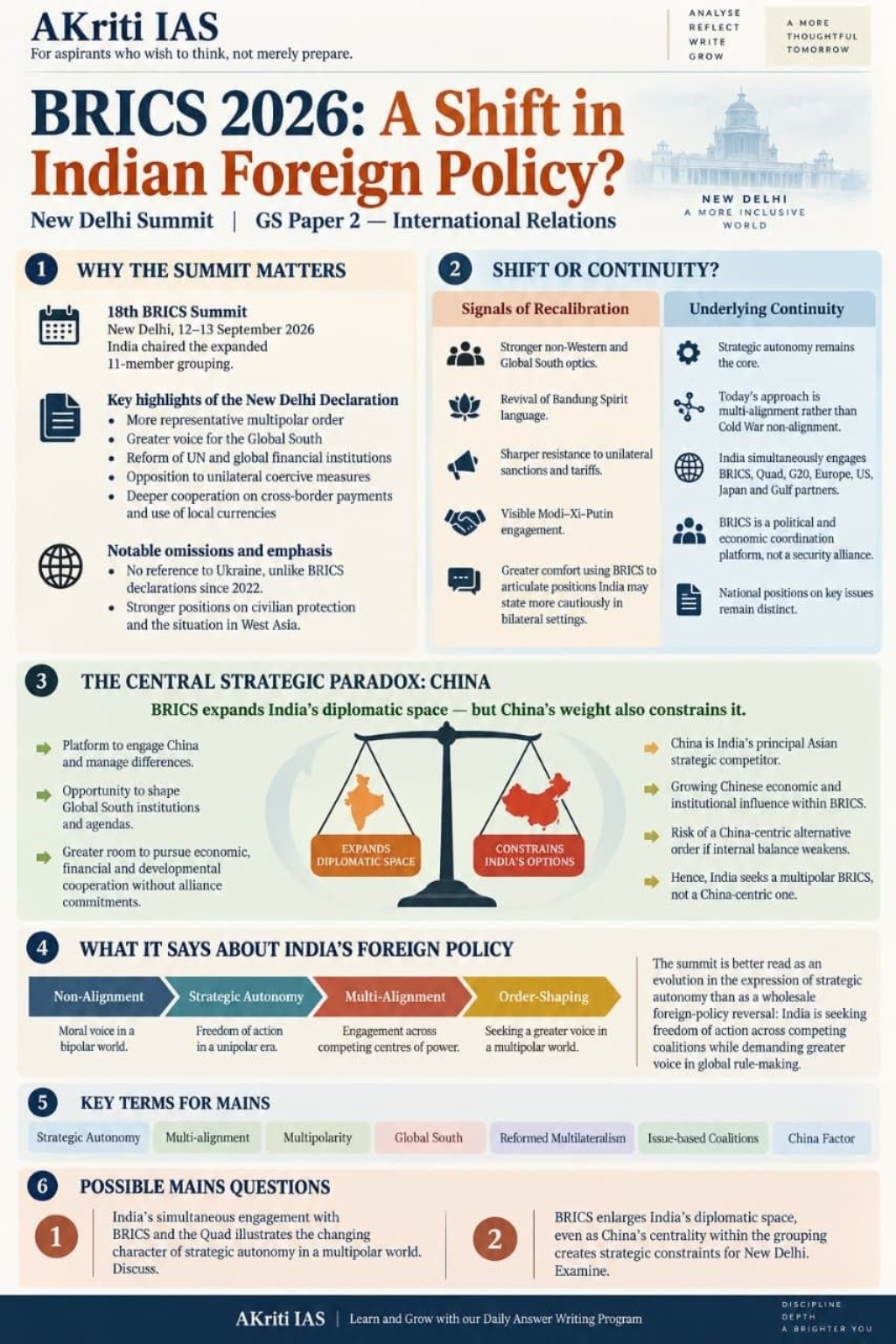
The 18th BRICS Summit and New Delhi Declaration are best read as a recalibration of India’s strategic autonomy. The grouping gives India a platform to press for a more representative multipolar order and a stronger Global South voice, while India continues to engage across competing centres of power.
The central tension is China. BRICS creates room for dialogue and cooperation with Beijing, but China’s economic and institutional weight can also constrain India’s choices. India’s approach therefore combines participation in BRICS with issue-based partnerships across the Quad, G20, Europe, the United States, Japan and Gulf partners.
Mains Connect: Assess BRICS as a platform that widens India’s room to shape a multipolar order, while examining how China’s centrality and intra-group differences limit the grouping’s strategic coherence.
AKriti IAS · GS Paper II · International Relations
29 September 2026 · 9 pagesGS II · GS III · Current Affairs
Seven developments · Mains-focused reading
NewsDigest: Seven developments. One exam-oriented reading.
The complete AKriti IAS edition selects seven high-value developments from The Hindu’s International Edition and maps them to the UPSC syllabus. Each issue offers analytical points and a Mains Connect.
UPI merchant charges and the legal basis of a digital fee
Rare-disease drugs: access alongside innovation
Iran–U.S. talks and energy security at Hormuz
Nepal’s floods and community-led recovery
Ladakh: representation, autonomy and national concerns
Israel’s Arab-party ban and democratic safeguards
RTI in Tamil Nadu: exemptions and institutional capacity
UPSC Current Affairs
GS II
GS III
Governance
International Relations
Federalism
Disaster Management
RTI
Source editionThe Hindu · International Edition · 29 September 2026
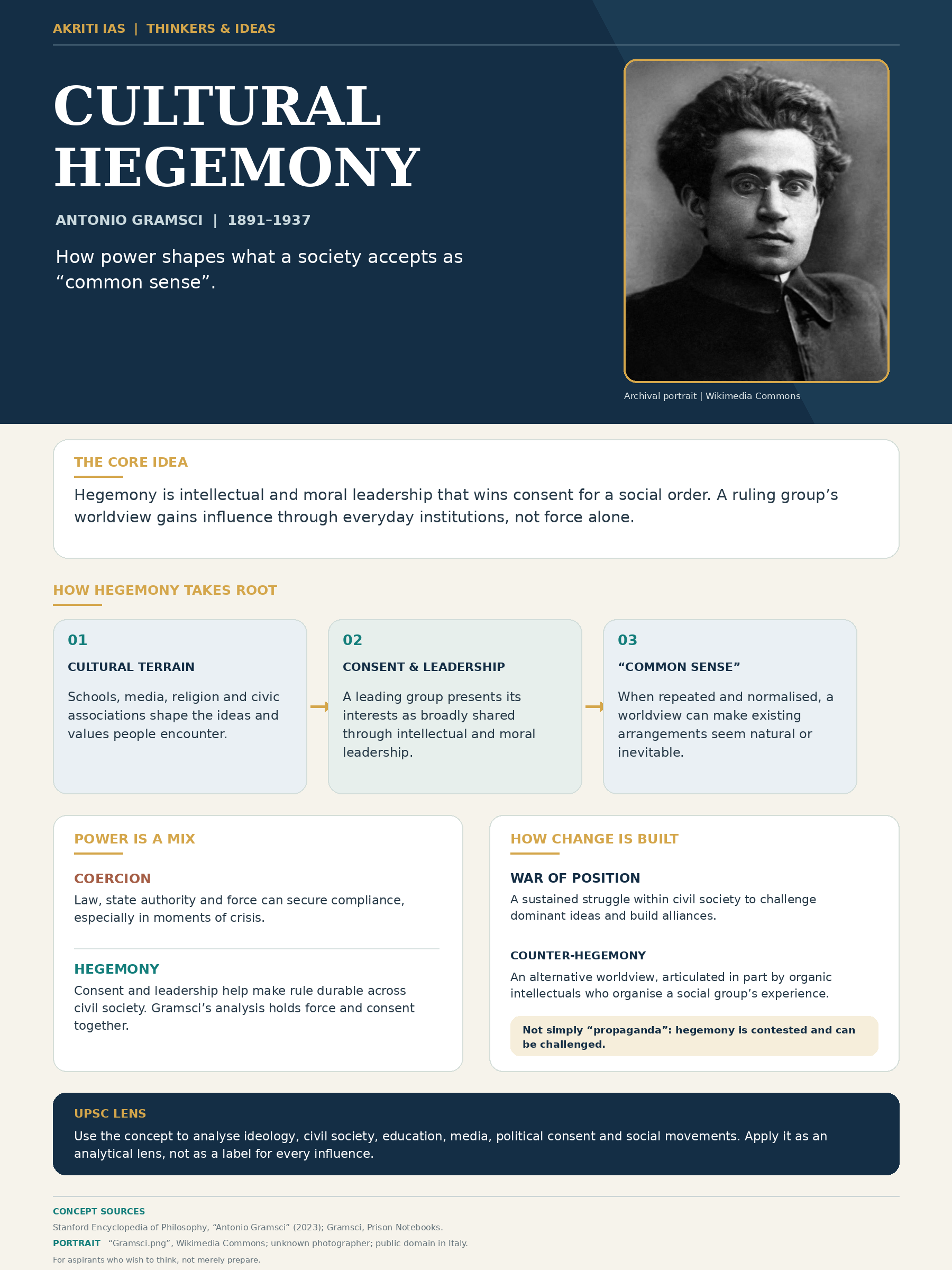
Antonio Gramsci’s Cultural Hegemony: Consent, Common Sense and Power
Antonio Gramsci used cultural hegemony to explain how a ruling group sustains leadership by winning consent as well as relying on state power. Its worldview can spread through everyday institutions and shape what people accept as “common sense.”
Schools, media, religion and civic associations form part of the cultural terrain where ideas and values take root. Gramsci’s analysis holds coercion and consent together: law and state authority can secure compliance, while intellectual and moral leadership can make a social order feel natural or widely shared.
Change involves a sustained “war of position” within civil society, building alliances and articulating counter-hegemonic ideas. The concept is an analytical lens for studying ideology, education, media, political consent and social movements.
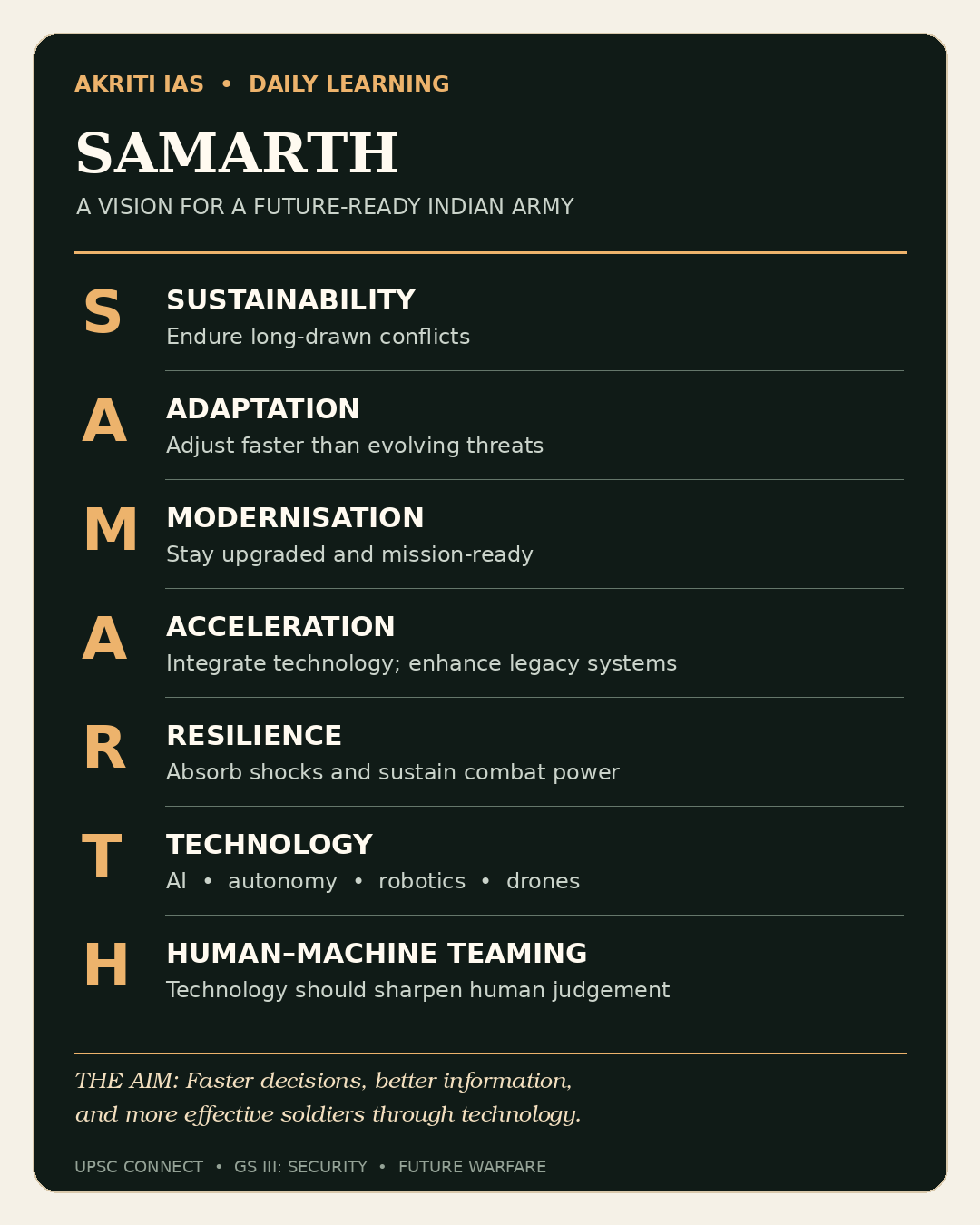
At the NDTV Defence Summit, Army Chief General Dhiraj Seth outlined SAMARTH—a seven-part vision for operational readiness in an era of changing warfare. It calls for a force able to endure long conflicts, adapt and modernise as threats evolve, and remain mission-ready.
The framework brings together sustainability, adaptation, modernisation, acceleration, resilience, technology and human–machine teaming. Acceleration means integrating capabilities that strengthen legacy systems while bringing in new technology. Examples named include AI, autonomous systems, robotics and drones.
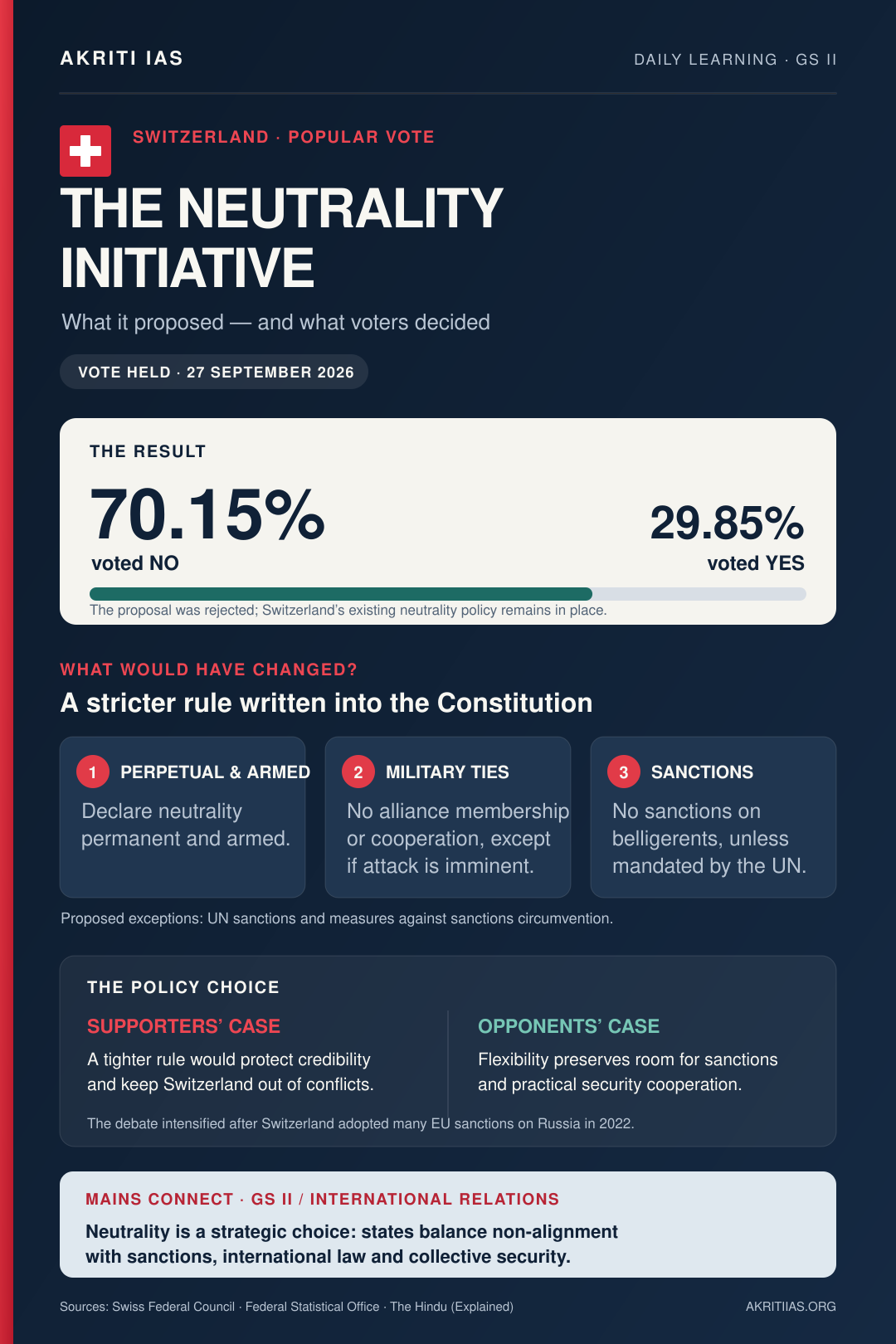
Switzerland’s Neutrality Initiative: what voters decided
On 27 September 2026, 70.15% of Swiss voters rejected a proposal to write a stricter form of neutrality into the Constitution. The result preserves the government’s room to interpret neutrality in light of Switzerland’s security and international obligations.
The initiative proposed “perpetual and armed” neutrality, tighter limits on military-alliance cooperation and a bar on sanctions against belligerents, with exceptions for UN sanctions and measures to prevent sanctions circumvention. Its campaign intensified after Switzerland adopted many EU sanctions on Russia following the 2022 invasion of Ukraine.
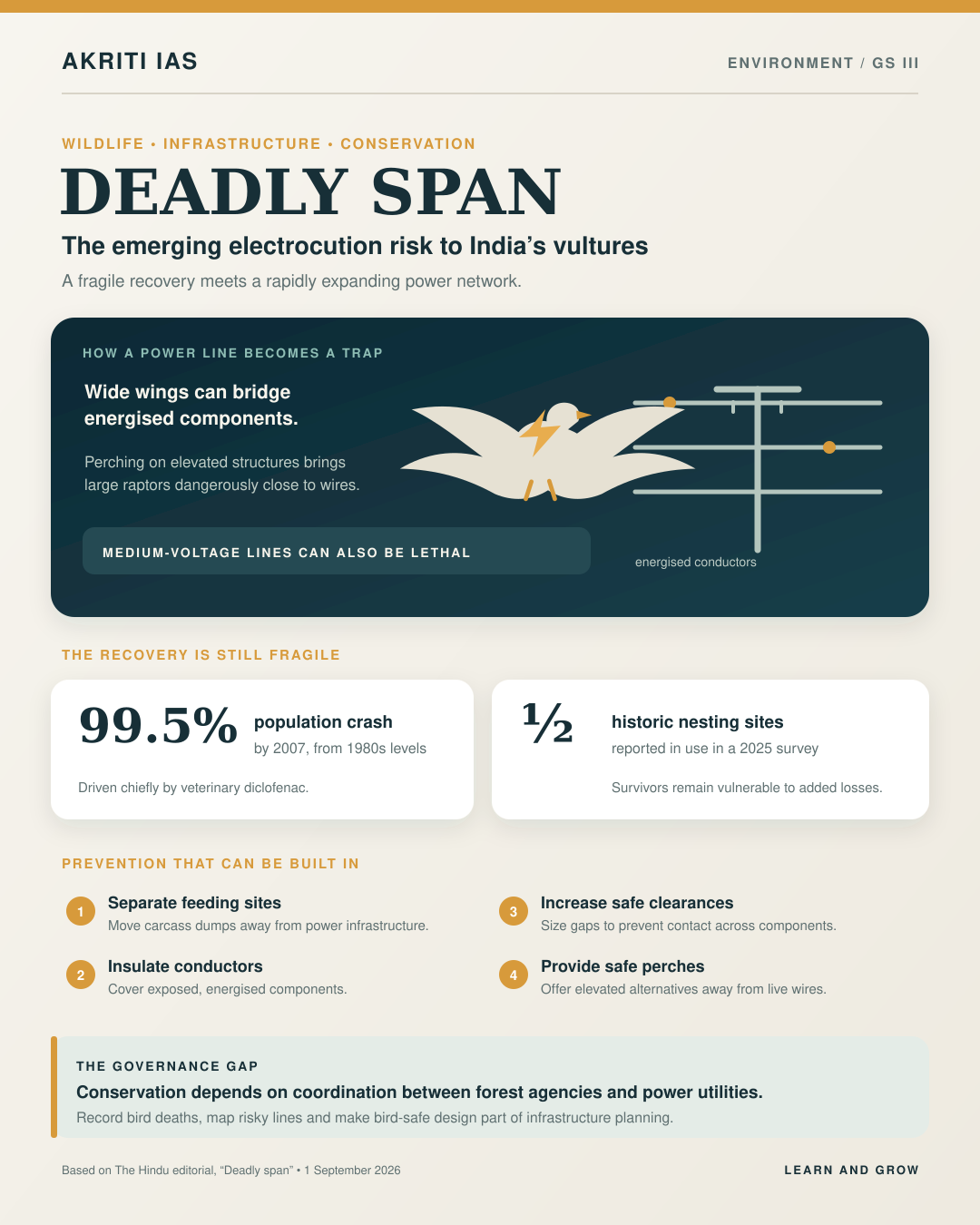
India’s vultures are still recovering from a catastrophic decline. Expanding power infrastructure creates an additional electrocution risk—one that may be hard to detect until local populations have already been harmed.
The infographic explains how wingspan and elevated perching can bring vultures into contact with electrical components, and sets out practical steps: safer clearances, insulated conductors, safe perches and feeding sites placed away from power lines.
This public section will bring together concise, carefully reasoned material for daily reading—content that helps readers connect evidence, institutions and ideas.